Implementasi Mesin Pencacah Rumput dan Mesin Pengaduk Pakan Dalam Penyiapan Pakan Sapi Perah
DOI:
https://doi.org/10.36526/tekiba.v6i3.9685Keywords:
Grass Chopper, Feed Mixer, Feed Preparation, Dairy Cattle, Appropriate TechnologyAbstract
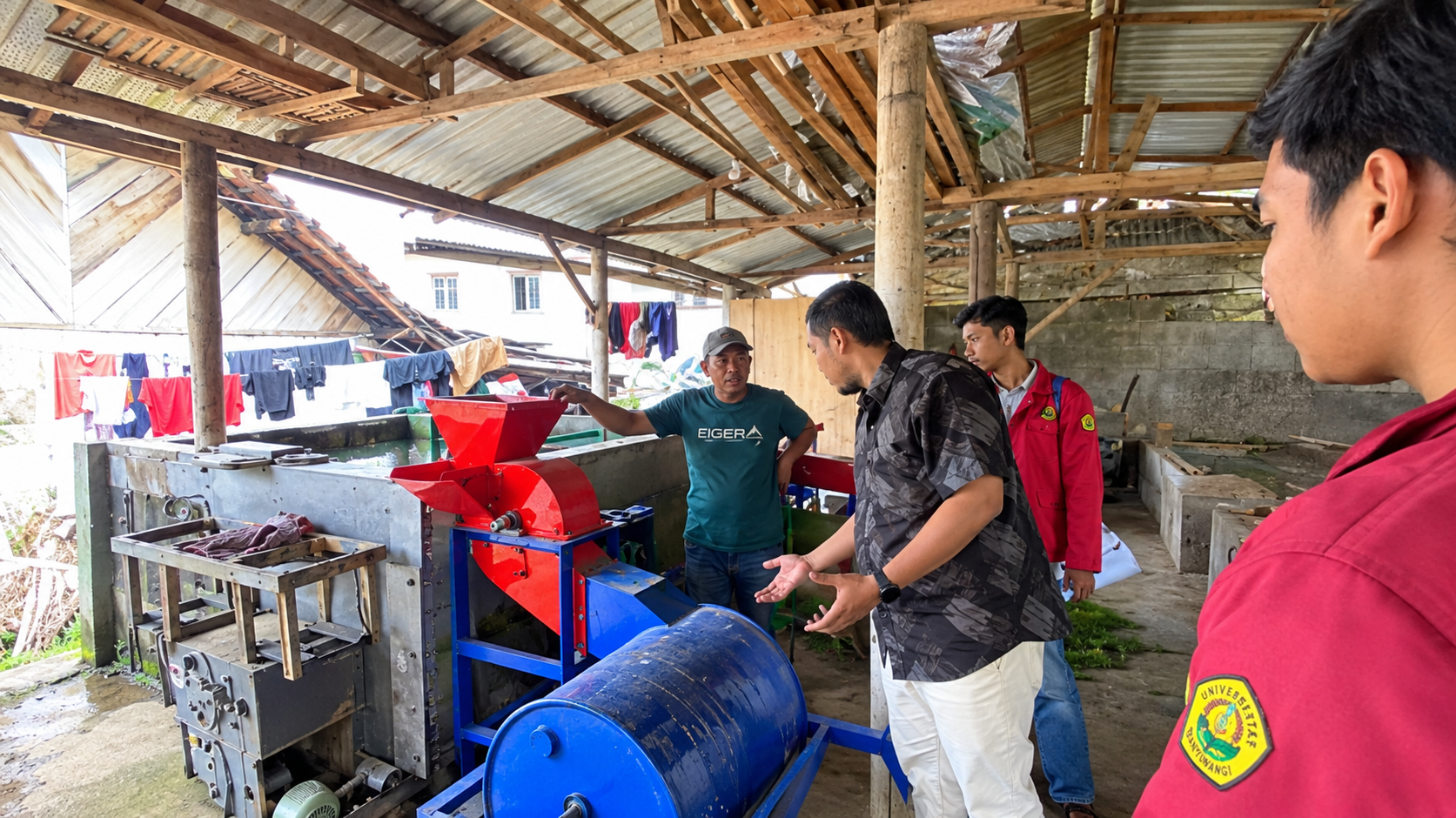
Dairy farmers in Kandang Tepus Village, Senduro District, Lumajang Regency, faced challenges in feed preparation because the processes of chopping forage and mixing feed were still performed manually. This resulted in lengthy feeding preparation times and required significant physical effort. This community service initiative aimed to implement grass-chopping and feed-mixing machines in the feed preparation process while enhancing the partners' ability to operate and perform basic maintenance on the equipment. The activity employed a participatory and applied approach across five stages: identifying partner needs and issues; designing and fabricating the technology; testing and refinement; training and technology implementation; and mentoring, monitoring, and evaluation. Prior to the technology's implementation, forage chopping was done using sickles, and feed ingredients were mixed by hand. Following implementation, chopping was mechanized producing cut lengths of approximately 2 to 3 cm and feed mixing was carried out using a mechanical mixer. Interviews with the partners indicated that the technology reduced feed preparation time by approximately 30% compared to the previous manual method. Training and mentoring outcomes demonstrated that the partners were capable of operating the grass-chopping and feed-mixing machines and performing basic equipment maintenance. The introduction of these two machines transformed the feed preparation process from one dominated by manual labor into a more mechanized and structured operation. This initiative demonstrates that implementing grass-chopping and feed-mixing machines—complemented by training and mentoring can improve feed preparation efficiency and enhance the partners' capacity to utilize and maintain the technology.
References
[1] T. Febrianti, S. I. Yanti, F. Awaliyah, and M. N. Adinasa, “Peran Koperasi Dalam Pengembangan Agribisnis Sapi Perah Di Kabupaten Garut,” Mahatani J. Agribisnis, vol. 8, no. 1, pp. 280–294, 2025, doi: https://doi.org/10.52434/mja.v8i1.42739
[2] P. Nugraha, R. Rifa’i, C. A. Maskur, and M. Ervandi, “Review Faktor – Faktor Yang Memengaruhi Produksi Susu Sapi Perah,” J. Sains Ternak Trop., vol. 2, no. 1, pp. 1–11, 2024, doi: https://doi.org/10.31314/jstt.2.1.1-11.2024
[3] S. T. Risyahadi, H. Afrilia, and S. Irawan, “Optimasi Formula Pakan Sapi Perah dengan Linier Programming untuk Minimasi Biaya Bahan Baku di Koperasi XYZ Jawa Tengah,” J. Ekon. dan Bisnis, vol. 10, no. 1, pp. 227–231, 2022, doi: https://doi.org/10.34308/eqien.v10i1.515
[4] R. F. Christi, D. Suharwanto, S. Suryanah, A. B. Salimah, and A. Sudrajat, “Pelatihan Kecukupan Kebutuhan Nutrisi Sapi Perah Periode Laktasi dan Kering Kandang di Kelompok Mitra Amanah Pagerageung Tasikmalaya,” Farmers J. Community Serv., vol. 6, no. 2, pp. 226–230, 2025, doi: https://doi.org/10.24198/fjcs.v6i1.60511
[5] N. S. Asminaya et al., “Pengenalan Manajemen Pemeliharaan Sapi Perah Berdasarkan Pedoman Good Dairy Farming Practice (GDFP) Di Desa Wesalo, Kabupaten Kolaka Timur,” BAKIRA J. Pengabdi. Kpd. Masy., vol. 5, no. 1, pp. 54–65, 2024, doi: https://doi.org/10.30598/bakira.2024.5.1.54-65
[6] A. Prima and A. Mahmud, “Teknologi Pengawetan Pakan Dengan Silase Hijauan di Kelompok Ternak Sapi Perah di Kecamatan Pujon, Kabupaten Malang,” J. Pengabdi. Masy. Peternak. Vol., vol. 6, no. 1, pp. 136–141, 2021, doi: http://dx.doi.org/10.35726/jpmp.v6i1.489
[7] S. Mulyati, I. Mustofa, Rimayanti, S. Susilowati, and Supriyadi, “Ekonomi Kreatif Pakan Tanpa Hijauan dan Inovasi Olahan Susu Menuju Wisata Sapi Perah,” Smart Dedication J. Pengabdi. Masy., vol. 2, no. 1, pp. 72–80, 2025, doi: https://doi.org/10.70427/smartdedication.v2i1.157
[8] Kaharudin and Bambang, “Rancang Bangun Mesin Pencacah Pakan Ternak Kapasitas 50 Kg/ Jam,” J. Sigmat Tek. Mesin Unsika, vol. 01, no. 02, pp. 1–8, 2021, doi: https://doi.org/10.35261/sigmat.v1i2.5555
[9] P. A. Suprapto and I. M. A. Adiaksa, “Penerapan Teknologi Tepat Guna Dalam Pengelolaan Pakan Peternakan Kambing di Mengwi Badung,” Madaniya, vol. 3, no. 4, pp. 831–837, 2022, doi: https://doi.org/10.53696/27214834.289
[10] M. Thohirin, A. G. Dityamri, and S. Wati, “Penerapan Mesin Cacah Multifungsi Berbasis Teknologi Tepat Guna untuk Meningkatkan Efisiensi Produksi Pakan Ternak di Desa Tulung Agung Gadingrejo,” JAMS J. Abdi Masy. Saburai, vol. 6, no. 1, pp. 85–93, 2025, doi: https://doi.org/10.24967/jams.v6i01.4288
[11] R. Ismail, M. Thohirin, and M. Y. R. Dalimunthe, “Rancang Bangun Mesin Pencacah Rumput Untuk Pakan Ternak,” Romli Ismail Muh Thohirin M. Yunus Ruslan Dalimunthe, vol. 2, no. 1, pp. 45–50, 2021, doi: https://doi.org/10.24967/psn.v2i1.1472
[12] R. Rofiaty and H. Nurul, “Transformasi Menuju Pengolahan Susu Ramah Lingkungan Berbasis Pemberdayaan Masyarakat: Integrasi Green Supply Chain pada Asosiasi Peternak Sapi Perah Pujon-Ngantang,” Abdimas Pedagog. J. Ilm. Pengabdi. Kpd. Masy., vol. 8, no. 1, pp. 98–111, 2025, doi: https://doi.org/10.17977/um050v8i12025p98-111
[13] Sulasmi and E. K. Sari, “Peran Company Management Dalam Daya Saing Peternak Sapi Perah di Kapanewon Cangkringan, Kabupaten Sleman,” Pangripta Sembada, vol. 2, no. 1, pp. 80–94, 2025, doi: https://doi.org/10.64174/jps.v2i1.37
[14] I. A. P. Bestari et al., “Peningkatan Produktivitas dan Pendapatan Kelompok Ternak ‘Manuk Lestari’ Melalui Teknologi Tepat Guna di Desa Abiansemal,” I-Com Indones. Community J., vol. 6, no. 2, pp. 617–624, 2026, doi: https://doi.org/10.70609/i-com.v6i2.9740
[15] A. Rahmat, A. Febrisiantosa, M. Mariyono, and Y. Kurniati, “Penerapan Teknologi Tepat Guna pada Perbaikan Pakan Kambing Perah dalam Peningkatan Produktifitas Susu Kambing,” Sustain. Soc. Impact, vol. 1, no. 1, 2024, doi: https://doi.org/10.64849/ssi.v1i1.32
[16] A. A. Spina et al., “Particle Size Distribution and Feed Sorting of Hay-Based and Silage-Based Total Mixed Ration of Calabrian Dairy Herds,” dairy, vol. 5, no. 1, pp. 106–117, 2024, doi: https://doi.org/10.3390/dairy5010009
[17] M. Sadeghi, G. R. Ghorbani, E. Ghasemi, S. Kargar, M. H. Ghaffari, and F. Ahmadi, “Effects of varying alfalfa hay-to-corn silage ratio and fat source on feed sorting behavior and chewing activities of lactating dairy cows,” Dairy Sci. Manag., vol. 2, no. 3, pp. 1–8, 2025, doi: https://doi.org/10.1186/s44363-025-00004-y
[18] R. J. Grant and K. W. Cotanch, “Perspective and Commentary: Chewing behavior of dairy cows: Practical perspectives on forage fiber and the management environment,” Appl. Anim. Sci., vol. 39, no. 3, pp. 146–155, 2023, doi: https://doi.org/10.15232/aas.2022-02371
[19] D. R. Gomide, R. A. N. Pereira, R. B. Silva, J. T. R. Carvalho, M. A. S. Lara, and M. N. Pereira, “Effect of Particle Size of Silage of Flint Corn Grain on Dairy Cows Fed Tropical Pasture: Performance, Intake, Ruminal Fermentation, and Digestibility,” animals, vol. 13, no. 12, pp. 1–18, 2023, doi: https://doi.org/10.3390/ani13121932
[20] I. G. M. A. Santos, A. R. Reibman, and J. P. Boerman, “A systematic review: methods to measure total mixed ration uniformity,” J. Dairy Sci., vol. 2, pp. 1–13, 2026, doi: https://doi.org/10.3168/jds.2026-28913
Downloads
Published
Issue
Section
License
Copyright (c) 2026 Dani Hari Tunggal Prasetiyo, Danang Yudistiro, Bambang Sri Kaloko, Gamma Aditya Rahardi, Daudie Aura Winata, Moch. Nawafil Fadilah, Aksal Dwi Ramadhani

This work is licensed under a Creative Commons Attribution-ShareAlike 4.0 International License.