Pelatihan Pemanfaatan Syngas Gasifikasi Limbah Kulit Kopi Menjadi Energi Listrik di Kecematan Silo
DOI:
https://doi.org/10.36526/tekiba.v6i2.8017Keywords:
Coffee Husk Waste, Gasification, Electricity, Pace Village, JemberAbstract
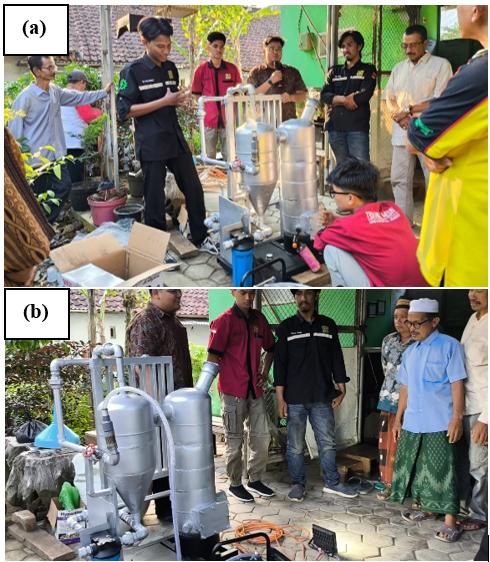
Jember Regency is a major coffee producer in East Java with high production volumes; however, the coffee processing activities generate large quantities of coffee husk waste that remain underutilized. The target partner, GAPOKTAN Suka Maju in Pace Village, Silo Sub-district, sells the waste at very low prices and lacks knowledge of gasification technology to convert it into electrical energy. This community engagement program aimed to raise awareness of the environmental impact of indiscriminate coffee husk disposal and to provide training on converting syngas from gasification into electricity. The service method consisted of pre-activity, implementation, and evaluation stages. Pre-activities included improvement, modification of the gasification equipment, and drying of the coffee husk waste. The implementation stage consisted of socialization and training on the use of the equipment. The modified gasifier is capable of producing up to 1020 watts of electricity at an air discharge of 40 SCFH. The success of the modified gasifier in generating electricity was demonstrated by a light that turn on after being connected to the system. The demonstration was successfully carried out to showcase the potential for converting coffee husk waste into electrical energy. In the evaluation stage, a questionnaire consisting of 10 questions was administered, followed by interviews. The activity was attended by 19 members of the GAPOKTAN. After the program, the partner gained new knowledge, a practical experience in operating the equipment, and opportunity to utilize coffee husk waste as an alternative energy source. Evaluation results showed a very high acceptance rate, with 95.8% positive responses. Furthermore, the participants experienced an increase in understanding, from an average of 47.37% before the program to an average of 86.87% after the program. In conclusion, the program successfully enhanced the partner’s insight and awareness, but ongoing technical assistance is required to maximize technology adoption.
References
[1] Filonchyk M, Peterson MP, Zhang L, et al. Greenhouse gases emissions and global climate change: Examining the influence of CO2, CH4, and N2O. Science of The Total Environment 2024;935:173359. https://doi.org/10.1016/j.scitotenv.2024.173359
[2] Ren J, Liu Y-L, Zhao X-Y, et al. Biomass thermochemical conversion: A review on tar elimination from biomass catalytic gasification. Journal of the Energy Institute 2020; 93:1083–98. https://doi.org/10.1016/j.joei.2019.10.003
[3] Clarke B, Otto F, Stuart-Smith R, et al. Extreme weather impacts of climate change: an attribution perspective. Environ Res: Climate 2022; 1:012001. https://doi.org/10.1088/2752-5295/ac6e7d
[4] Shah IH, Manzoor MA, Jinhui W, et al. Comprehensive review: Effects of climate change and greenhouse gases emission relevance to environmental stress on horticultural crops and management. Journal of Environmental Management 2024; 351:119978. https://doi.org/10.1016/j.jenvman.2023.119978
[5] Stump Á, Szabó-Morvai Á. The effect of air pollution on fertility in 657 European regions. Journal of Environmental Economics and Management 2025; 130:103111. https://doi.org/10.1016/j.jeem.2024.103111
[6] Wu Y, Zhang Y, Wang J, et al. Genetic evidence for the causal effects of air pollution on the risk of respiratory diseases. Ecotoxicology and Environmental Safety 2025; 290:117602. https://doi.org/10.1016/j.ecoenv.2024.117602
[7] Zhang Y, Hou D, Sun X, et al. Different pretreatment of biomass for gasification: A critical review. Journal of the Energy Institute 2025; 119:101992. https://doi.org/10.1016/j.joei.2025.101992
[8] Patel P, Dimitriou I, Mondal P, et al. Process optimisation and enviro-economic assessment of carbon-negative hydrogen production from biomass co-gasification. Energy Conversion and Management 2025; 323:119211. https://doi.org/10.1016/j.enconman.2024.119211
[9] Ajorloo M, Ghodrat M, Scott J, et al. Evaluating the role of feedstock composition and component interactions on biomass gasification. Fuel 2025; 381:133528. https://doi.org/10.1016/j.fuel.2024.133528
[10] Kushwah A, Reina TR, Short M. Modelling approaches for biomass gasifiers: A comprehensive overview. Science of the Total Environment 2022; 834:155243. https://doi.org/10.1016/j.scitotenv.2022.155243
[11] Singh H, Ranjan N, Kumar S. Biomass to electricity: A comparative techno-economic and feasibility study of decentralized air and oxy-steam gasification power technologies. Journal of Cleaner Production 2025; 489:144733. https://doi.org/10.1016/j.jclepro.2025.144733
[12] Ferreiro AI, Ferreira AF, Fernandes EC, et al. Influence of process parameters on biomass gasification: A review of experimental studies in entrained flow reactors and droptube furnaces. Biomass and Bioenergy 2024; 185:107217. https://doi.org/10.1016/j.biombioe.2024.107217
[13] Wang F, Peng W, Zeng X, et al. Insight into staged gasification of biomass waste: Essential fundamentals and applications. Science of The Total Environment 2024; 953:175954. https://doi.org/10.1016/j.scitotenv.2024.175954
[14] BPS Provinsi Jawa Timur. Provinsi Jawa Timur dalam Angka 2024. vol. 47. BPS Provinsi Jawa Timur; 2024.
[15] Septianingtyas Purwandhini A, Wahyu Pudjiastutik E, Exwin Suhaeriyah N. Analisis Perwilayahan Komoditas Kopi. J. Sos. Ekon. Pertan 2023; 19:167–78. https://doi.org/10.20956/jsep.v19i2.25124
[16] Ruesgas-Ramón M, Figueroa-Espinoza MC, Durand E, et al. Identification and quantification of phytoprostanes and phytofurans of coffee and cocoa by- and co-products. Food Funct 2019; 10:6882–91. https://doi.org/10.1039/C9FO01528K
[17] Rodrigues JP, Ghesti GF, Silveira EA, et al. Waste-to-hydrogen via CO2/Steam-enhanced gasification of spent coffee ground. Cleaner Chemical Engineering 2022; 4:100082. https://doi.org/10.1016/j.clce.2022.100082
[18] Uwaoma RC, Strydom CA, Bunt JR, et al. Co-gasification reactivity and kinetics of municipality and coffee waste residue hydrochar and South African density separated coal blends. Bioresource Technology Reports 2021; 16:100877. https://doi.org/10.1016/j.biteb.2021.100877
[19] serayunusantara.com. Petik Kopi Merah, Bupati Jember Kenalkan Varietas Kopi Milo Robusta - Serayu Nusantara 2023. https://serayunusantara.com/petik-kopi-merah-bupati-jember-kenalkan-varietas-kopi-milo-robusta/ (accessed January 1, 2025).
[20] Nashrullah MD, Sanata A, Sholahuddin I, et al. Sosialisasi dan Pelatihan Pemanfaatan Limbah Kulit Kopi sebagai Sumber Energi Alternatif bagi Gabungan Kelompok Tani di Kecamatan Silo, Kabupaten Jember: Socialization and Training on Utilizing Coffee Husk Waste as an Alternative Energy Source for Farmer Groups in Silo Subdistrict, Jember District. Pengabdianmu J Ilmiah Pengabdian Masyarakat 2025; 10:1856–62. https://doi.org/10.33084/pengabdianmu.v10i8.9097
[21] Sanata A, Sholahuddin I, Nashrullah MD, et al. Characteristics of syngas combustion resulting from coffee husk biomass waste gasification process: Overview of automotive fuel alternatives. Mech Eng for Soc and Ind 2024; 4:210–22. https://doi.org/10.31603/mesi.12590
[22] Ridwan M, Indradjaja I, Nugraha N, et al. Pengujian Kinerja Dan Modifikasi Reaktor Downdraft Gasifikasi Biomassa 100 kW. jrh 2018;2. https://doi.org/10.26760/jrh.v2i2.2394
[23] Situmorang YA, Zhao Z, Yoshida A, et al. Small-scale biomass gasification systems for power generation (<200 kW class): A review. Renewable and Sustainable Energy Reviews 2020; 117:109486. https://doi.org/10.1016/j.rser.2019.109486
[24] Makwana J, Dhass AD, Ramana PV, et al. An analysis of waste/biomass gasification producing hydrogen-rich syngas: A review. International Journal of Thermofluids 2023; 20:100492. https://doi.org/10.1016/j.ijft.2023.100492
[25] Shen Y. Biomass pretreatment for steam gasification toward H2-rich syngas production – An overview. International Journal of Hydrogen Energy 2024; 66:90–102. https://doi.org/10.1016/j.ijhydene.2024.04.096
Downloads
Published
Issue
Section
License
Copyright (c) 2026 Muhammad Dimyati Nashrullah, Andi Sanata, Imam Sholahuddin, Dani Hari Tunggal Prasetiyo, Elvira Wahyu Arum Fanani, Dwi Wahyu Hardiyanto, Faizah Ali, M. Thoriq Akbar Fauzi, Ricky Kurnia Yudistira, Brayen Jovanda, Muhammad Kaka Gabriel Ilah, Faqih Noval

This work is licensed under a Creative Commons Attribution-ShareAlike 4.0 International License.