Pemberdayaan Masyarakat melalui Penyuluhan Hukum Lingkungan dan Penerapan Biopori-Biopot di Paguyuban Blok EM Rogojampi
DOI:
https://doi.org/10.36526/tekiba.v6i3.9571Keywords:
Community Empowerment, Environmental Law, Organic Waste, Biopores and Biopots, Appropriate TechnologyAbstract
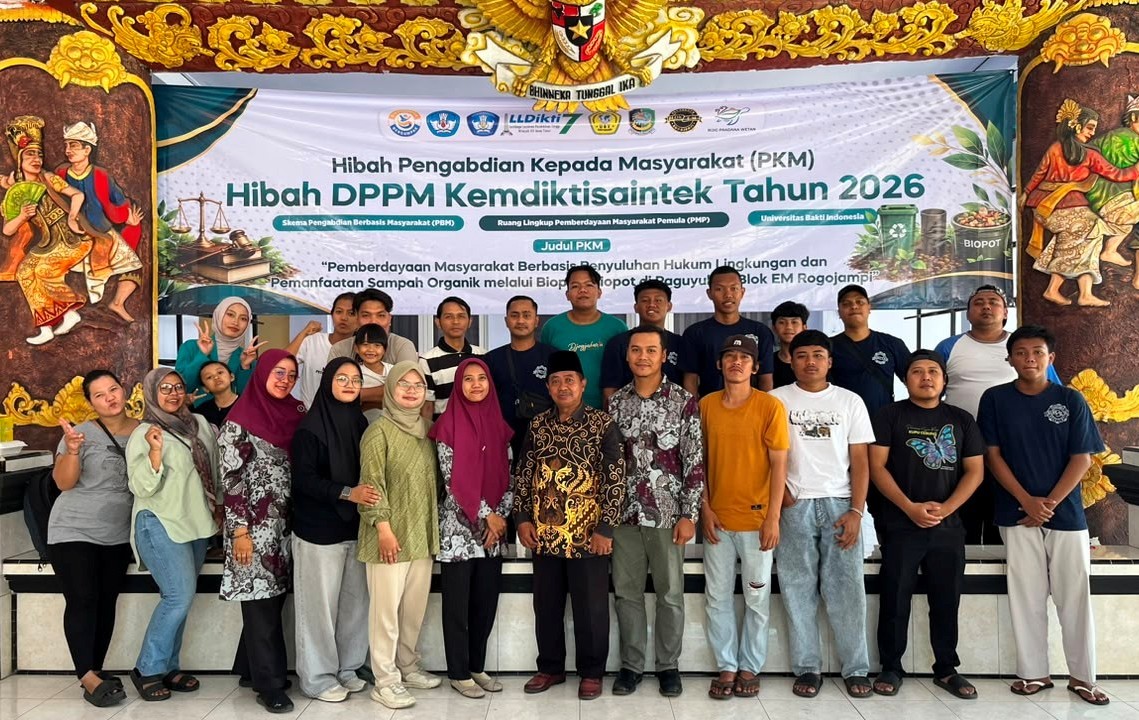
Household waste management in the Blok EM Community, Rogojampi Village, Banyuwangi, remains suboptimal, particularly in household waste sorting and the continued practice of open burning, accompanied by limited knowledge of household waste management and environmental law. This community service program aimed to strengthen residents’ knowledge of environmental law, improve their skills in managing household organic waste, and enhance community participation through the application of biopore infiltration holes and biopots. The program targeted members of the Blok EM Community, with 26 participants completing both pretest and posttest assessments. A participatory approach was employed, comprising initial assessment, environmental-law counseling, demonstrations and hands-on training, implementation, mentoring, monitoring, and evaluation. The mean knowledge score increased from 56.35 to 82.81, representing an absolute increase of 26.46 points. The mean individual normalized gain (N-Gain) was 0.57 (57.09%), which falls within the medium category. The program also resulted in the installation of 25 biopore units and 25 biopot units in communal and household areas. Initial monitoring indicated that residents began directing organic household waste to the installed facilities and showed reduced reliance on waste burning. These findings suggest that integrating environmental-law counseling with simple household-scale waste-management technologies and participatory mentoring can strengthen community capacity and support more sustainable waste-management practices. However, the program did not include a control group or quantitative baseline measurements of waste generation, burning frequency, infiltration rate, or compost yield. Therefore, the observed behavioral changes should be interpreted as preliminary outcomes requiring longer-term monitoring.
References
[1] Hidayati, Putri RR, Abida IW, Yuhardi E, Ayisi CL. Production of Eco-enzyme as a Solution to Organic Waste Management. Bubungan Tinggi J Pengabdi Masy 2025; 7:684–91. https://doi.org/DOI: https://doi.org/10.20527/btjpm.v7i3.14310
[2] Republik Indonesia. Undang-Undang Republik Indonesia Nomor 18 Tahun 2008 Tentang Pengelolaan Sampah Dengan Tambahan Lembaran Negara Republik Indonesia. https://peraturan.bpk.go.id/Details/39067/uu-no-18-tahun-2008
[3] Tristianoka A, Ikbal M, Mahesa YR, Hidayat D, Dikrurahman D. Community Legal Awareness in Waste Management in Cirebon City. J Res Soc Sci Econ Manag 2023; 4:1–11. https://doi.org/10.59141/jrssem.v3i08.559
[4] World Health Organization. Open waste burning-sectoral solutions for air pollution and health. Geneva World Heal Organ 2025. https://www.who.int/publications/i/item/B09367
[5] World Health Organization. Global conference on air pollution and health: clean air, clean energy access and climate change mitigation Global conference on air pollution and health: Accelerating action for. Geneva World Heal Organ 2025. https://www.who.int/
[6] Badu RR, Lukum W, Tahir MR, Sm F. Efektivitas Teknologi Biopori dengan Pengolahan Sampah Organik untuk Meningkatkan Laju Infiltrasi Tanah. J Teknol Pertan Gorontalo 2023; 8:2–9. https://doi.org/https://doi.org/10.30869/jtpg.v8i2.1260
[7] Wardini SK, Putri WTA, Miarsyah M, Ristanto RH. Pengembangan Virus Electronic Module Articulate Storyline 3 (Vieral) dalam Meningkatkan Kemampuan Berpikir Kritis 2024;9. https://doi.org/https://doi.org/10.37058/bioed.v9.i2.4227
[8] Lolo EU, Gunawan RI, Krismani AY, Pambudi YS, Sudaryantingsih C, Widianto, et al. Processing of Organic Waste Using Biopori Infiltration Holes (Case Study: Organic Waste at Christian University of Technology Solo). East Asian J Multidiscip Res 2023; 2:1675–88. https://doi.org/10.55927/eajmr.v2i4.3903
[9] Kustiandi JK, Agydamar Putra Dewangga, Ahmad Fadhil, Alfiyyah Nur Tsabitah. Pemanfaatan Sampah Organik Melalui Pembuatan Biopori dan Kampanye Visual di TPS3R Sumbergondo. J-Dinamika J Pengabdi Masy 2025; 10:297–304. https://doi.org/10.25047/j-dinamika.v10i2.6299
[10] Anyanwu LE, Felix OO, Ejike IW, Anyanwu IO. Community-based waste management strategies and their impact on urban sustainability through citizen participation and local government collaboration. World J Adv Res Rev 2025; 28:1638–50. https://doi.org/10.30574/wjarr.2025.28.2.3809
[11] A KRR, Praveena D. Success Cases in Community Participatory Approaches in South Asia: A Systematic Review 2026; 8:1–10. https://www.ijfmr.com/research-paper.php?id=69363
[12] Wang H, Tong M. Research on Community Participation in Environmental Management of Ecotourism. Int J Bus Manag 2009; 4:131–5. https://doi.org/10.5539/ijbm.v4n3p131
[13] Paspama JA. Manufacturing Mini Biopories with Organic Waste Using Used Goods 2024; 3:18–21. https://paspama.org/index.php/abdimas/article/view/134
[14] Putra FA, Santoso SI, Setiadi A, Saputra AD, Ikhfannida W, Putra C, et al. Biopore Effectiveness in Increasing Soil Organic Carbon and Addressing Environmental Issues. J Reka Lingkung 2026; 14:71–84. DOI: https://doi.org/10.26760/rekalingkungan.v14i1.71-84
[15] Singgih R, Indra RR, Majid A, Alihsan S, Ismaya F, Jainab A, et al. Community Empowerment Through Biopore Creation as an Effort to Mitigate Flood and Organic Waste Management 2026;2:92–6. doi: https://doi.org/10.38035/sncsr.v2i2.699
[16] Simanjuntak I V., Setiyadi, Mulyani AS, Hutabarat LE. The effectiveness of biopore technology on infiltration rate and organic waste processing. IOP Conf Ser Earth Environ Sci 2021; 878:0–7. https://doi.org/10.1088/1755-1315/878/1/012045
[17] Hayatullah A, Mursyidah H, Anggara D, Hayati S, Kurnia I, Karis M. Journal of Research Applications in Sebagai Sumber Kompos Dan Pencegahan Banjir Bagi. J Res Appl Community Serv 2025; 4:1–10. https://doi.org/DOI: https://doi.org/10.32665/jarcoms.v4i1.4097
[18] Sarminingsih A, Sumiyati S, Syafrudin, Andika AF, Balqis M. Effect of Variation of Eco-Enzyme Addition on Macro Nutrient Content of Compost with Biopore Infiltration Holes. E3S Web Conf 2023;448. https://doi.org/10.1051/e3sconf/202344803035
[19] Hayat M, Sáez-Sandino T, Wang J, Li J, Zhou G, Singh BK. Compost-Based Organic Amendments and Synthetic Fertilisers Enhance Soil Health and Crop Yield Worldwide. J Sustain Agric Environ 2026; 5:1–12. https://doi.org/10.1002/sae2.70157
[20] Asaah-Junior SK, Agyiri FOP. Climate Change and Legal Literacy Consciousness: The Untold Stories from Ghanaian High Schools. Aust J Environ Educ 2026:1–22. https://doi.org/10.1017/aee.2026.10171
[21] Rohadi M, Pramucitra R, Pinandita S, Anwar S. Environmental Conservation Education through Biopore Introduction for Elementary School Students at Sanggar Belajar Kuala Lumpur. J Community Empower 2025; 5:7–12. DOI: https://doi.org/10.15294/jce.v5i1.27445
[22] Elashry ME, Khater EG, Ali SA. Modeling and kinetic analysis of structural disintegration and biodegradation of biocomposite cultivating pots from agricultural waste. Sci Rep 2025; 15:1–16. https://doi.org/10.1038/s41598-025-30302-z
[23] Ruslinda Y, Haqqoni MA, Lestari RA, Gunawan H. Performance Analysis of Biopore Infiltration Hole (Bih) Composting Base on Soil Texture and Water Infiltration Rate. ARPN J Eng Appl Sci 2022; 17:1594–601. https://www.arpnjournals.org/jeas/research_papers/rp_2022/jeas_0922_9010.pdf
[24] Kasjono HS. Pemberdayaan Masyarakat Melalui Pelatihan Pengelolaan Sampah Organik Berbasis Biopori bagi Kader Kesehatan Puskesmas Depok 2026; 6:115–23. DOI: https://doi.org/10.30640/abdimas45.v5i2.7719
[25] Phothisawang W, Apornpong T, Arpornpong N. Effects of Source-Based Waste Management Awareness on Waste Segregation Behavior Among Lower Secondary School Students in Thailand: A Case Study of Phitsanulok Province. Sustainability 2026; 18:1–22. https://doi.org/https://doi.org/10.3390/su18063101
[26] Singgih R, Indra RR, Majid A, Alihsan S, Ismaya F. Community Empowerment Through Biopore Creation as an Effort to Mitigate Flood and Organic Waste Management 2026;2:92–6. doi: https://doi.org/10.38035/sncsr.v2i2.699
Downloads
Published
Issue
Section
License
Copyright (c) 2026 Nuri Hidayati, Thorieq Moh. Yusuf, Rima Suwistika

This work is licensed under a Creative Commons Attribution-ShareAlike 4.0 International License.