Seminar Digital Penguatan Sumber Daya Manusia Pendidikan Tinggi Menuju Indonesia Emas 2045
DOI:
https://doi.org/10.36526/tekiba.v6i2.7643Keywords:
Community Service, Digital Seminar, Higher Education, Human Resources, Indonesia Gold 2045Abstract
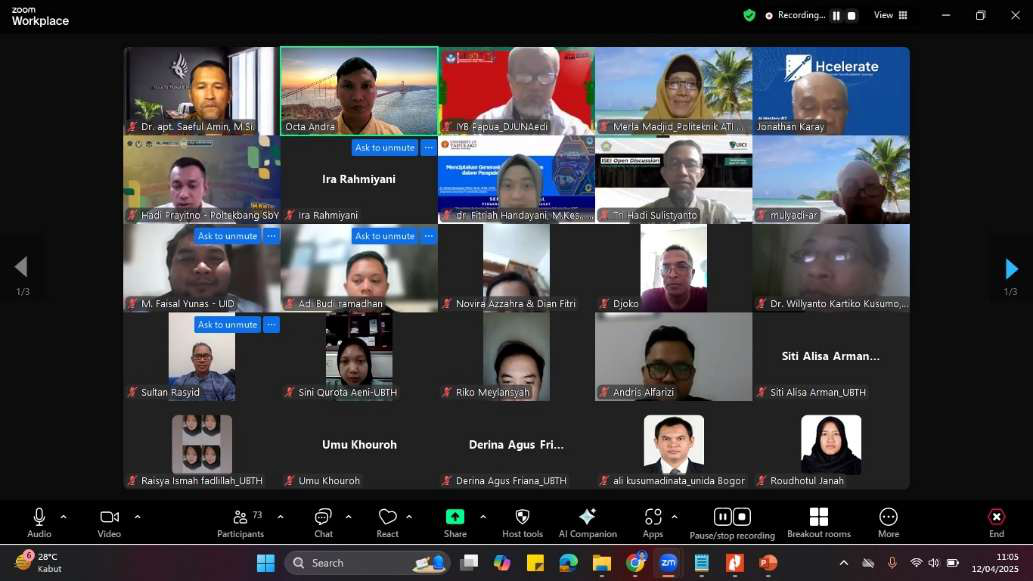
Indonesia Gold 2045 requires higher education institutions to strengthen academic human resources who are adaptive, innovative, and globally competitive. However, lecturers and education personnel still need practical understanding of competency development, learning innovation, and cross-sector collaboration strategies. This community service program aimed to strengthen participants' literacy on competitive human resource development through a national digital seminar. The activity was conducted online via Zoom on 12 April 2025 using a participatory approach consisting of preparation, educational material delivery, interactive discussion, monitoring, evaluation, and follow-up publication. The participants were 93 lecturers and education personnel from higher education institutions in Indonesia. Evaluation was conducted using a Likert-scale questionnaire through Google Forms and analysed descriptively. The results showed that the activity was well received: 66.3% of participants were lecturers and 33.7% were education personnel; the average scores for material benefit, material relevance, and media suitability were 3.71; the knowledge and applicable skill improvement score reached 3.85; and the speaker's delivery score also reached 3.85 on a 1-4 scale. The findings indicate that digital community service seminars can improve practical awareness, academic networking, and readiness to develop competitive human resources. The program output includes a data-based evaluation report, documentation of implementation, and recommendations for regular follow-up activities, including deeper discussion of Artificial Intelligence for human resource development.
References
[1] Prayitno H. Laporan Pengabdian kepada Masyarakat: Seminar Nasional Pengabdian kepada Masyarakat Menciptakan Sumber Daya Manusia Unggul dan Berdaya Saing untuk Menyongsong Indonesia Emas 2045. Surabaya: Politeknik Penerbangan Surabaya; 2025.
[2] Republik Indonesia. Undang-Undang Republik Indonesia Nomor 59 Tahun 2024 tentang Rencana Pembangunan Jangka Panjang Nasional Tahun 2025-2045. Jakarta: Sekretariat Negara; 2024.
[3] Kementerian Pendidikan, Kebudayaan, Riset, dan Teknologi. Peraturan Menteri Pendidikan, Kebudayaan, Riset, dan Teknologi Nomor 53 Tahun 2023 tentang Penjaminan Mutu Pendidikan Tinggi. Jakarta: Kemendikbudristek; 2023.
[4] Kementerian Perencanaan Pembangunan Nasional/Bappenas. Rencana Pembangunan Jangka Panjang Nasional 2025-2045: Indonesia Emas 2045. Jakarta: Kementerian PPN/Bappenas; 2024.
[5] UNESCO. Reimagining Our Futures Together: A New Social Contract for Education. Paris: UNESCO; 2021.
[6] UNESCO. Beyond Limits: New Ways to Reinvent Higher Education. Paris: UNESCO; 2022.
[7] UNESCO. AI and Education: Guidance for Policy-makers. Paris: UNESCO; 2021.
[8] UNESCO. Guidance for Generative AI in Education and Research. Paris: UNESCO; 2023.
[9] World Economic Forum. The Future of Jobs Report 2023. Geneva: World Economic Forum; 2023.
[10] World Economic Forum. The Future of Jobs Report 2025. Geneva: World Economic Forum; 2025.
[11] OECD. OECD Digital Education Outlook 2023: Towards an Effective Digital Education Ecosystem. Paris: OECD Publishing; 2023. doi: https://doi.org/10.1787/c74f03de-en
[12] OECD. Education at a Glance 2024: OECD Indicators. Paris: OECD Publishing; 2024. doi: https://doi.org/10.1787/c00cad36-en
[13] EDUCAUSE. 2024 EDUCAUSE Horizon Report: Teaching and Learning Edition. Boulder: EDUCAUSE; 2024.
[14] EDUCAUSE. 2025 EDUCAUSE Horizon Report: Teaching and Learning Edition. Boulder: EDUCAUSE; 2025.
[15] Crompton H, Burke D. Artificial intelligence in higher education: the state of the field. Int J Educ Technol High Educ. 2023; 20:22. doi: https://doi.org/10.1186/s41239-023-00392-8
[16] Chan CKY, Hu W. Students' voices on generative AI: perceptions, benefits, and challenges in higher education. Int J Educ Technol High Educ. 2023; 20:43. doi: https://doi.org/10.1186/s41239-023-00411-8
[17] Kasneci E, Sessler K, Kuechemann S, Bannert M, Dementieva D, Fischer F, et al. ChatGPT for good? On opportunities and challenges of large language models for education. Learn Individ Differ. 2023; 103:102274. doi: https://doi.org/10.1016/j.lindif.2023.102274
[18] Tlili A, Shehata B, Adarkwah MA, Bozkurt A, Hickey DT, Huang R, et al. What if the devil is my guardian angel: ChatGPT as a case study of using chatbots in education. Smart Learn Environ. 2023; 10:15. doi: https://doi.org/10.1186/s40561-023-00237-x
[19] Holmes W, Tuomi I. State of the art and practice in AI in education. Eur J Educ. 2022;57(4):542-570. doi: https://doi.org/10.1111/ejed.12533
[20] Ouyang F, Jiao P. Artificial intelligence in education: the three paradigms. Computers and Education: Artificial Intelligence. 2021; 2:100020. doi: https://doi.org/10.1016/j.caeai.2021.100020
Downloads
Published
Issue
Section
License
Copyright (c) 2026 Hadi Prayitno, Ahmad Bahrawi, Faoyan Agus Furyanto, Ikhwanul Qiram

This work is licensed under a Creative Commons Attribution-ShareAlike 4.0 International License.