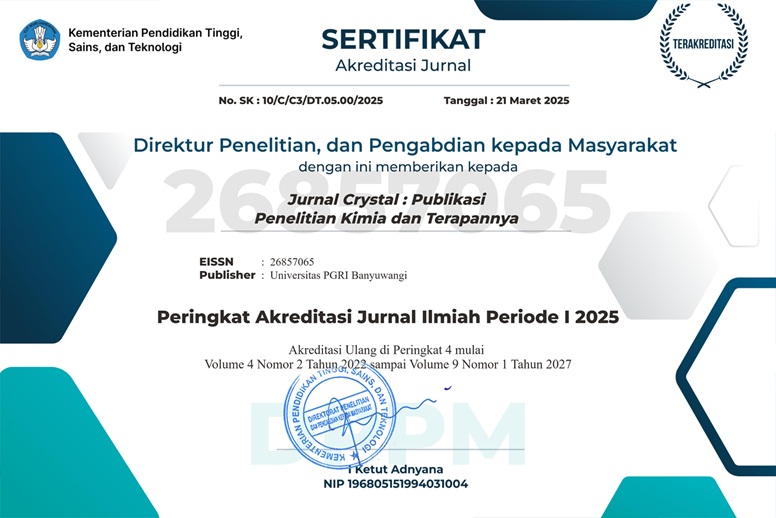
Optical and Electrical Characterization of CuSnO₃ and ZnO Semiconductor Materials Using UV–Vis DRS and Four-Point Probe
DOI:
https://doi.org/10.36526/jc.v8i2.9112Keywords:
CuSnO₃, ZnO, band gap, konduktivitas, UV-Vis DRS, four-point probeAbstract
This study aimed to characterize the optical and electrical properties of CuSnO₃ and ZnO oxide semiconductor materials. The experimental procedure included the synthesis of CuSnO₃ thin films using the sol-gel method combined with the spin-coating technique on glass substrates, followed by calcination at 550°C. ZnO layers were subsequently deposited onto the CuSnO₃ films using the doctor-blade method and calcined at 350°C, 400°C, and 450°C. The materials were characterized using UV–Vis diffuse reflectance spectroscopy (UV–Vis DRS), the Four-Point Probe (FPP) method, and SEM–EDS. The results showed that CuSnO₃ exhibited a band gap of 2.3 eV, a resistivity of 0.5–1.0 Ω·cm, and a conductivity of 1.0–2.0 S/cm. ZnO exhibited a band gap of 3.3–3.4 eV, while increasing the calcination temperature reduced its resistivity to 10–50 Ω·cm and increased its conductivity to 0.10 S/cm. The CuSnO₃/ZnO heterostructure shows promising potential for applications in photovoltaic devices, gas sensors, and light-emitting diodes (LEDs).
References
Abdullahi, S. S., Güner, S., Koseoglu, Y., Musa, I. M., Adamu, B. I., & Abdulhamid, M. I. (2016). Sımple Method For The Determınatıon of Band Gap of a Nanopowdered Sample Usıng Kubelka Munk Theory. Journal of the Nigerian Association of Mathematical Physics, 35, 241–246.
Abolhasani, M. (2025). Sonochemical synthesis of CuSnO3 NPs as a photocatalyst for efficient degradation of MB and environmental remediation. Physica B Condensed Matter, 717. https://doi.org/10.1016/j.physb.2025.417837
Andia-Huaracha, S. C., Zapana-Cayo, L. M., Aragón, F. F. H., Aquino, J. C. R., Coaquira, J. A. H., Gonzales-Lorenzo, C. D., Ayala-Arenas, J. S., Solis, J. L., Morais, P. C., & Pacheco-Salazar, D. G. (2022). Tuning the photocatalytic activity of ZnO nanoparticles by the annihilation of intrinsic defects provoked by the thermal annealing. Journal of Nanoparticle Research, 24(3). https://doi.org/10.1007/s11051-022-05421-7
Arab, L., Amri, A., Meftah, A., Latif, A., Tibermacine, T., & Sengouga, N. (2023). Effect of the annealing process on the properties of ZnO thin films prepared by the sol-gel method. Chemical Physics Impact, 7(April), 100266. https://doi.org/10.1016/j.chphi.2023.100266
Benramache, S., Belahssen, O., & Temam, H. Ben. (2014). Effect of band gap energy on the electrical conductivity in doped ZnO thin film. Journal of Semiconductors, 35(7), 1–4. https://doi.org/10.1088/1674-4926/35/7/073001
Bernardi, J. (2021). Energy-dispersive X-ray spectroscopy. Imaging Modalities for Biological and Preclinical Research: A Compendium, Volume 1: Part I: Ex Vivo Biological Imaging, 1, I.9.e-1-I.9.e-9. https://doi.org/10.1088/978-0-7503-3059-6ch41
Chelly, A., Glass, S., Belhassen, J., & Karsenty, A. (2023). Broad review of four-point probe correction factors: Enhanced analytical model using advanced numerical and experimental cross-examination. Results in Physics, 48(April), 106445. https://doi.org/10.1016/j.rinp.2023.106445
Dihan Kurnia Saputra, Sherly Kasuma Warda Ningsih, H. (2025). M a s l i q. 5(September 2025), 2227–2236.
Faizah, S. H., Sanjaya, H., & Budiman, S. (2024). Pengaruh Penambahan Monoetanolamin (MEA) pada Sifat Listrik dari Material Copper Tin Oxide. Masaliq, 4(1), 308–313. https://doi.org/10.58578/masaliq.v4i1.2506
Gurylev, V., & Perng, T. P. (2021). Defect engineering of ZnO: Review on oxygen and zinc vacancies. Journal of the European Ceramic Society, 41(10), 4977–4996. https://doi.org/10.1016/j.jeurceramsoc.2021.03.031
Julita, M., Shiddiq, M., & Khair, M. (2022). Determination of Band Gap Energy of ZnO/Au Nanoparticles Resulting in Laser Ablation in Liquid. Indo. J. Chem. Res., 10(2), 83–87. https://doi.org/10.30598//ijcr.2022.10-mar
Karishma. (2024). Efficiency assessment of perovskite solar cells: A focus on hole transporting layers. In Solar Energy (Vol. 282). https://doi.org/10.1016/j.solener.2024.112967
Kasim, M. F., Rusdi, R., Kamil, S. A., & Kamarulzaman, N. (2012). The effect of annealing temperature on the band gap of ZnO nano materials. Advanced Materials Research, 545, 165–168. https://doi.org/10.4028/www.scientific.net/AMR.545.165
Kim, B. N., Seo, G. K., Hwang, S. W., Yu, H., Ahn, B., Seo, H., & Cho, I. S. (2018). Photophysical properties and photoelectrochemical performances of sol-gel derived copper stannate (CuSnO3) amorphous semiconductor for solar water splitting application. Ceramics International. https://doi.org/10.1016/j.ceramint.2017.10.119
Krysova, H., Mansfeldova, V., Tarabkova, H., Pisarikova, A., Hubicka, Z., & Kavan, L. (2024). High-quality dense ZnO thin films: work function and photo/electrochemical properties. Journal of Solid State Electrochemistry, 28(8), 2531–2546. https://doi.org/10.1007/s10008-023-05766-6
Landi, S. (2022). Use and misuse of the Kubelka-Munk function to obtain the band gap energy from diffuse reflectance measurements. Solid State Communications, 341. https://doi.org/10.1016/j.ssc.2021.114573
Molaei, P. (2025). Engineering ZnO/g-C₃N₄ Heterostructures for Enhanced Photocatalytic Performance under Solar Irradiation. https://scispace.com/papers/engineering-zno-g-c3n4-heterostructures-for-enhanced-hzob1nxzbbmb
Moltved, K. A., & Kepp, K. P. (2019). The chemical bond between transition metals and Oxygen: Electronegativity, d-Orbital Effects, and Oxophilicity as Descriptors of Metal-Oxygen Interactions. Journal of Physical Chemistry C, 123(30), 18432–18444. https://doi.org/10.1021/acs.jpcc.9b04317
Nandi, S., Kumar, S., & Misra, A. (2021). Zinc oxide heterostructures: Advances in devices from self-powered photodetectors to self-charging supercapacitors. Materials Advances, 2(21), 6768–6799. https://doi.org/10.1039/d1ma00670c
Narudin, N., Ekanayake, P., Soon, Y. W., & Nakajima, H. (2021). Experimental data of four-point probe, scanning electron microscopy, and near-edge X-ray fine structure of titanium (IV) isopropoxide and zirconium (IV) dioxide binders incorporated carbon-based counter electrode for dye-sensitized solar cells. Data in Brief, 39, 107487. https://doi.org/10.1016/j.dib.2021.107487
Pandey, P., Parra, M. R., Haque, F. Z., & Kurchania, R. (2017). Effects of annealing temperature optimization on the efficiency of ZnO nanoparticles photoanode based dye sensitized solar cells. Journal of Materials Science: Materials in Electronics, 28(2), 1537–1545. https://doi.org/10.1007/s10854-016-5693-9
Patel, V. D., & Gupta, D. (2025). Optoelectronic simulation and optimization of all perovskites tandem solar cells employing electrodeposited copper oxide as hole transport layer. Scientific Reports, 15(1), 1–15. https://doi.org/10.1038/s41598-025-93982-7
Putri, T. J., Sanjaya, H., & Budiman, S. (2024). Sintesis dan Aplikasi CuSnO3 sebagai Katalis pada Proses Degradasi Zat Warna Methyl Orange dengan Metode Fotolisis. Masaliq, 4(1), 456–462. https://doi.org/10.58578/masaliq.v4i1.2672
Sanjaya, H., Aziz, H., Stiadi, Y., Arief, S., Yohandri, Y., & Budiman, S. (2026). Preparation of Thin Film CuSnO3 by Dip Coating Method: Structural, Optical, and Electrical Properties for Dye-Sensitized Solar Cell Applications. Jurnal Kimia Valensi, 12(1), 110–118. https://doi.org/10.15408/jkv.v12i1.50326
Shahzad, S., Javed, S., & Usman, M. (2021). A Review on Synthesis and Optoelectronic Applications of Nanostructured ZnO. Frontiers in Materials, 8(April), 1–16. https://doi.org/10.3389/fmats.2021.613825
Stadler, A. (2012). Transparent Conducting Oxides—An Up-To-Date Overview. Materials, 5(4), 661–683. https://doi.org/10.3390/ma5040661
Syafrian, S., & Sanjaya, H. (2024). Pengaruh Perbedaan Suhu Kalsinasi terhadap Band Gap dan Konduktivitas Listrik Lapisan Tipis CuSnO3. Masaliq, 4(2), 508–515. https://doi.org/10.58578/masaliq.v4i2.2751
Tiwale, N., Senanayak, S. P., Rubio-Lara, J., Alaverdyan, Y., & Welland, M. E. (2019). Optimization of Transistor Characteristics and Charge Transport in Solution Processed ZnO Thin Films Grown from Zinc Neodecanoate. Electronic Materials Letters, 15(6), 702–711. https://doi.org/10.1007/s13391-019-00173-4
Yadav, A., Varshan, A. G., Nayak, S., Wu, J. Y., & Thanasekaran, P. (2025). Structural, morphological, dielectric and semiconducting properties of ZnO nanoparticles calcined at 500 °C. RSC Advances, 15(44), 36749–36759. https://doi.org/10.1039/d5ra06276d
Yang, S., Lei, G., Xu, H., Lan, Z., Wang, Z., & Gu, H. (2021). Metal oxide based heterojunctions for gas sensors: A review. Nanomaterials, 11(4), 1–26. https://doi.org/10.3390/nano11041026
Zhang, W., Liu, Z., Liu, Z., & Zhao, J. (2012). Effect of calcination temperature on the structural and optical properties of ZnO:Fe powders. Applied Surface Science, 258(16), 6103–6106. https://doi.org/10.1016/j.apsusc.2012.03.011
Zhao, K. (2025). A novel organic/inorganic NH2-UiO-66/ZnO heterojunction for enhanced photocatalytic H2O2 production in pure water. Chemical Communications. https://doi.org/10.1039/d5cc04650e
Zhao, K., Munir, R., Yan, B., Yang, Y., Kim, T., & Amassian, A. (2015). Solution-processed inorganic copper(i) thiocyanate (CuSCN) hole transporting layers for efficient p-i-n perovskite solar cells. Journal of Materials Chemistry A, 3(41), 20554–20559. https://doi.org/10.1039/c5ta04028k
Published
How to Cite
Issue
Section
License
Copyright (c) 2026 Sylvia Syafniati Putri

This work is licensed under a Creative Commons Attribution 4.0 International License.