Pelatihan Oshibana Berbasis Sains Sebagai Upaya Pengembangan Literasi Pada Bahan Alam
DOI:
https://doi.org/10.36526/tekiba.v6i3.9734Keywords:
Oshibana, Flower, Creative, Art, WorkshopAbstract
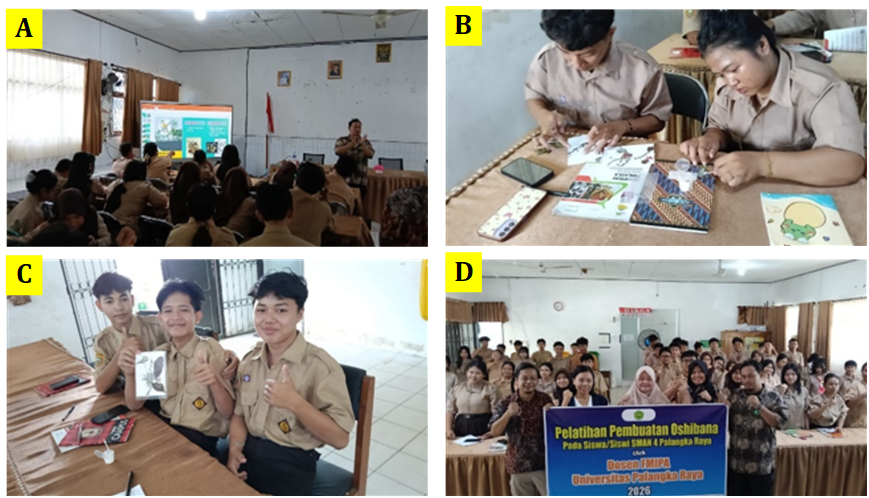
Oshibana is an art form that involves transforming dried flowers and other plant parts, preserved using pressing techniques, into artworks with aesthetic and economic value. Currently, the diversity of plants in the school environment is not fully utilized for practical learning. These plants can help students develop their knowledge and skills in preserving leaves and flowers through drying and pressing techniques. This activity can also improve students’ creativity and introduce them to entrepreneurship through the development of creative products from natural materials. This workshop aimed to enhance students’ knowledge and skills while introducing the potential of Oshibana products as part of the creative economy. The activity was conducted at SMA N 4 Palangka Raya and involved 38 students. The implementation methods consisted of a pre-test, instructional sessions, hands-on practice in creating Oshibana, evaluation through a post-test, and a participant satisfaction survey. The results demonstrated an improvement in students’ understanding of Oshibana following the training, increasing from 68% in the pre-test to 97% in the post-test. The survey results indicated that 81% of participants were satisfied to highly satisfied with the implementation of the activity, while 71% expressed the need for follow-up activities. These findings demonstrate that Oshibana training is effective in enhancing students’ knowledge and skills in transforming plant materials into creative art products. The resulting products have the potential to be further developed into decorative items, greeting cards, bookmarks, and various other creative products with economic value.
References
[1] F. Ariyantiningsih, F. K. I. Nikmah, and D. Wulandari, “Bunganomics: Ketika Bunga Jadi Simbol Cinta dan Peluang Bisnis,” vol. 4, no. 11, 2025, doi: https://doi.org/10.36841/jme.v4i11.7956
[2] A. H. Shah, A. Singh, N. Laishram, and K. Gill, “Income Generation through Value Addition of Flower Crops: A Review,” IJECC, pp. 593–613, May 2022, doi: https://doi.org/10.9734/ijecc/2022/v12i1030838
[3] Firda Septiana Sanar, Rais Rais, Hemenius R Solossa, Ria Angela, and Susana Magdalena Welly Muskita, “Mengembangkan Kreativitas Pembuatan Buket Bunga Di Kalangan Jiwa Muda Berwirausaha,” JUKERDI, vol. 1, no. 4, pp. 11–21, Jul. 2024, doi: https://doi.org/10.61132/jukerdi.v1i4.263
[4] T. Rahayu and A. Hayati, “Pelatihan Keterampilan Herbarium Kering Modern bagi Guru dan Siswa di SMK Negeri 2 Batu,” ABDIMAS J. Pengabdi. Masy. Univ. Merdeka Malang, vol. 5, no. 2, pp. 123–130, Jul. 2020, doi: https://doi.org/10.26905/abdimas.v5i2.3413
[5] Y. E. Utami, Y. Bustami, H. J. Duda, and F. R. E. Wahyuni, “Pemanfaatan Herbarium Tamanan Berbunga melalui Inovasi Oshibana sebagai ‘Art Pressed Flower’ Pada Siswa/i SMA Ketungau Tengah,” vol. 2, no. 1, pp. 1–6, 2026, doi: https://doi.org/10.51826/senentang.v2i1.2013.
[6] E. Riandini, R. Supriati, and R. R. S. Astuti, “Edukasi Saintifik Oshibana Sebagai Sarana Kreativitas di Lembaga Kesejahteraan Ssosial Anak (LKSA) Guyub Rukun Kota Bengkulu,” Jurnal Pengabdian Indonesia, 2(02). 2022 Retrieved from https://jkfn.akfaryarsiptk.ac.id/index.php/japin/article/view/66
[7] L. Guo et al., “Which horticultural activities are more effective for children’s recovery from stress and mental fatigue? A quasi-experimental study,” Front. Psychol., vol. 15, p. 1352186, Apr. 2024, doi: https://doi.org/10.3389/fpsyg.2024.1352186
[8] Z. G. Long et al., “Spatially resolved detection of small molecules from press‐dried plant tissue using MALDI imaging,” Appl Plant Sci, vol. 11, no. 5, p. e11539, Sep. 2023, doi: https://doi.org/10.1002/aps3.11539
[9] F. Susilo, J. Nasution, and R. Rahmiati, “Pemanfaatan Tanaman Pekarangan dalam Upaya Peningkatan Kreativitas Remaja Melalui Teknik Oshibana,” Pelitamasyarakat, vol. 2, no. 2, pp. 118–124, Mar. 2021, doi: https://doi.org/10.31289/pelitamasyarakat.v2i2.4992
[10] W. Andini, M. B. Darmawan, Y. P. Harahap, U. Hasanah, and R. Septiany, “Pendidikan Kreatif Seni Bunga Tekan (Oshibana) Bagi Siswa SMPIT NURUL FAJAR Sebagai Sarana Mencintai Biodiversitas Tanaman Indonesia,” 2014. https://repository.ipb.ac.id/handle/123456789/73777
[12] D. S. Macchindra and R. G. Khandekar, “Advanced drying and preservation techniques for flowers: A review,” Journal of Ornamental Horticulture, vol. 28, no. 1, pp. 1–8, 2025, doi: https://doi.org/10.5958/2249-880X.2025.00002.4
[13] R. K. Rabeler et al., “Herbarium Practices and Ethics, III,” Systematic Botany, vol. 44, no. 1, pp. 7–13, Feb. 2019, doi: https://doi.org/10.1600/036364419X697840
[14] N. Hikmah, E. S. Rahayu, and S. Saptono, “Development of Plantae Taxonomy Garden as a Contextual Learning Resource of Plantae Subject in High School Biology,” vol. 10, no. 3, pp. 306–313, Dec. 2021, doi: https://doi.org/10.15294/jise.v10i1.45240
[15] T. Y. Wowat, A. Arrijani, and M. N. Tanor, “Penerapan Praktikum Berbasis Lingkungan untuk Meningkatkan Pemahaman Konsep Spermatophyta di SMP Negeri 4 Manado,” vol. 2, no. 2, pp. 162–178, Jun. 2025, doi: https://doi.org/10.61132/jucapenbi.v2i2.360
[16] M. H. Irawati et al., “Pelatihan Oshibana Berbasis Keragaman Tumbuhan untuk Penguatan Kreativitas Siswa dan Edukasi SDGs di SMAN Taruna Nala Malang,” lumbung. inov. pengab. masya, vol. 11, no. 2, pp. 460–473, Jun. 2026, doi: https://doi.org/10.36312/linov.v11i2.5260
[17] C. Y. Nadi, “Pelatihan Pembuatan Aksesori Berbahan Resin dan Bunga Kering Bersama Mahasiswa Program Studi S-1 Pendidikan Kimia Universitas Sebelas Maret,” vol. 4, no. 1, 2023, doi: https://doi.org/10.24821/jps.v4i1.9524
[18] N. Manurung, Y. Fefiani, N. Mardiana, and S. M. Sani, “Pencandraan Vegetasi Menggunakan Aplikasi QR Code Sebagai Pengadaan Laboratorium Alam Di Lingkungan Sekolah Madrasah Aliyah Negeri 2 Deli Serdang Lubuk Pakam,” vol. 7, no. 2, pp. 1397–1403, 2024, doi: https://doi.org/10.30743/best.v7i2.10769
[19] M. Muswita, U. Yelianti, T. Sukmono, H. Harlis, and W. D. Kartika, “Pelatihan Pembuatan Herbarium Sebagai Media Pembelajaran Biologi di SMAN 11 Muaro Jambi,” Universitas Jambi, vol. 3, no. 2, pp. 170–175, Dec. 2019, doi: https://doi.org/10.22437/jkam.v3i2.8479
[20] J.-P. Ayotte-Beaudet et al., “Exploring the impacts of contextualised outdoor science education on learning: the case of primary school students learning about ecosystem relationships,” Journal of Biological Education, vol. 57, no. 2, pp. 277–294, Mar. 2023, doi: https://doi.org/10.1080/00219266.2021.1909634
[21] M. Kumar, V. Chaudhary, U. Sirohi, and A. L. Srivastav, “Economically viable flower drying techniques to sustain flower industry amid COVID-19 pandemic,” Environ Dev Sustain, vol. 26, no. 9, pp. 22103–22148, May 2023, doi: https://doi.org/10.1007/s10668-023-03376-w
[22] S. Yan, Y. Li, J. Liu, D. Si, and X. Zhang, “Guideline for extraction, qualitative, quantitative, and stability analysis of anthocyanins,” eFood, vol. 4, no. 1, p. e59, Feb. 2023, doi: https://doi.org/10.1002/efd2.59
[23] A. S. Hapsari and D. Lutfiati, “Pemanfaatan Pressed Flowers sebagai Dekorasi Undangan Pernikahan,” vol. 2, no. 1, pp. 1–10, 2020, doi: https://doi.org/10.26740/jbc.v2n1.p1-10
Downloads
Published
Issue
Section
License
Copyright (c) 2026 Lilis Rosmainar, Siti Sunariyati, Vinsen Willi Wardhana, Rasidah Rasidah, Luqman Hakim

This work is licensed under a Creative Commons Attribution-ShareAlike 4.0 International License.