REVIEW PROCESS POLICY
The TRANSFORMASI: Jurnal Pendidikan Matematika & Matematika applies a double-blind peer-review process. The identities of the authors are concealed from the reviewers, and the identities of the reviewers are not disclosed to the authors. Every manuscript that passes initial editorial screening is evaluated by at least two independent reviewers with relevant subject, methodological, or mathematical expertise. We appoint a third reviewer when the first two reports conflict substantially, one report is inadequate, or additional expertise is required.
Every manuscript is submitted and processed through OJS. The editorial team first checks the three mandatory submission documents, metadata completeness, template compliance, anonymization, ethical requirements, and similarity-screening results.
Manuscripts that pass initial editorial screening are evaluated through double-blind peer review by at least two independent reviewers. When the reports conflict substantially, a report is inadequate, or additional expertise is required, the editor may appoint a third reviewer.
Reviewer recommendations inform the editorial decision but do not determine it automatically. Authors requested to revise must submit an anonymized revised manuscript and a detailed point-by-point response. A manuscript may undergo more than one revision round.
Formal acceptance is recorded in OJS only after the required reviews and revisions have been completed. A Letter of Acceptance is issued after formal acceptance, followed by copyediting, proofreading, production, and publication.
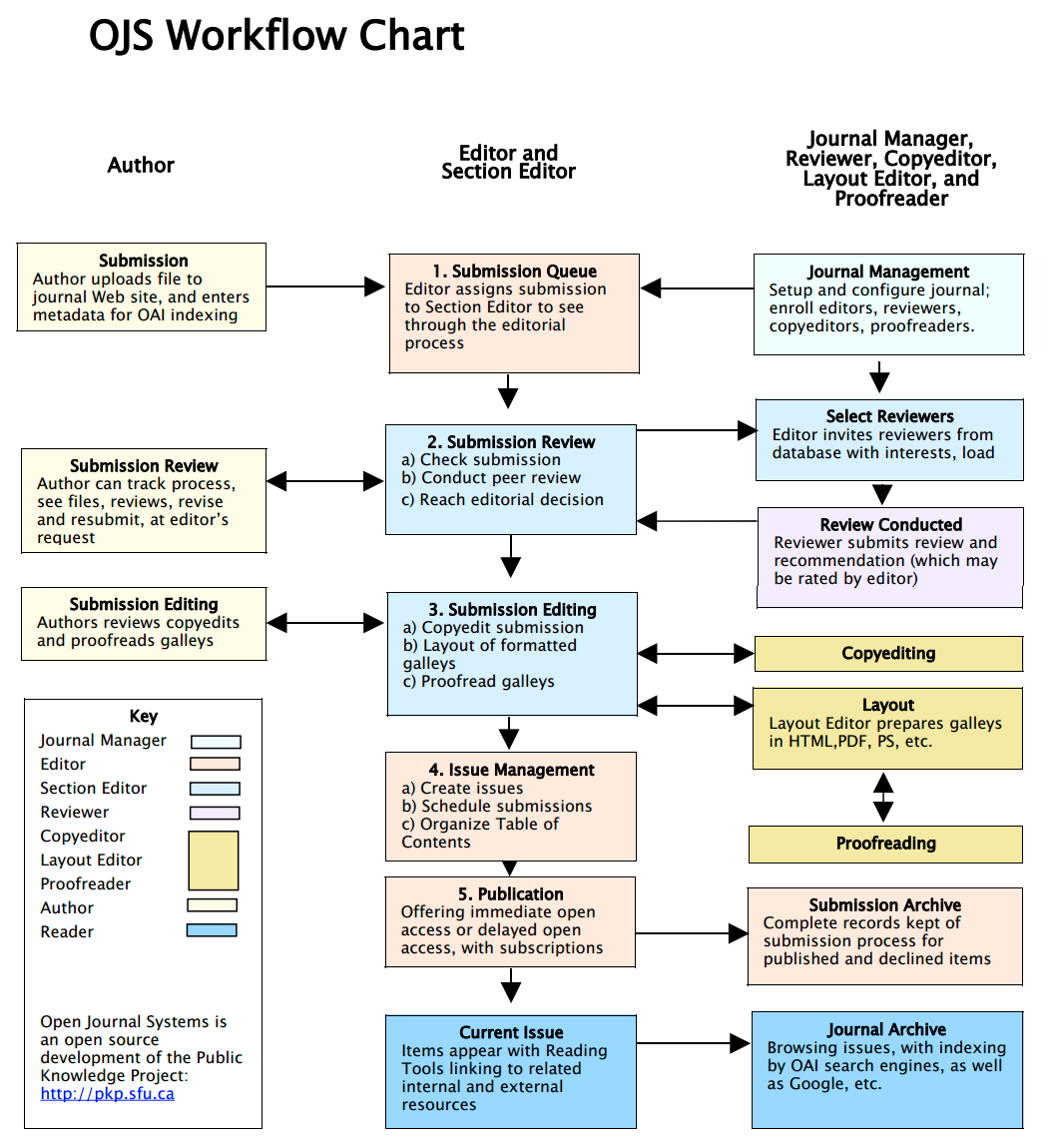
All submissions, reviewer assignments, review reports, revisions, editorial correspondence, and decisions are processed and documented through the journal’s Open Journal Systems (OJS) platform.
Initial Editorial Screening
The Editor-in-Chief or an assigned editor conducts an initial screening before external review. The assessment covers:
- alignment with the Focus and Scope of TRANSFORMASI: Jurnal Pendidikan Matematika & Matematika;
- originality and significance of the scholarly contribution;
- relevance to an international readership;
- clarity of the research problem, state of the art, and research gap;
- appropriateness of the research design and analysis;
- methodological and mathematical quality;
- compliance with the Author Guidelines and manuscript template;
- completeness of the manuscript and supporting files;
- compliance with research and publication ethics; and
- similarity-screening results.
The initial screening is normally completed within seven working days after the submission files and metadata have been confirmed as complete.
A manuscript may be rejected without external review when it:
- falls outside the journal’s scope;
- lacks a clear theoretical, empirical, methodological, educational, or policy contribution;
- presents only a limited descriptive report;
- repeats an established intervention without meaningful advancement;
- contains serious methodological or analytical weaknesses;
- makes claims unsupported by its design, data, or analysis;
- fails to meet the journal’s submission requirements;
- contains serious ethical or integrity concerns; or
- does not meet the journal’s minimum academic and presentation standards.
A desk-rejection decision does not require external reviewer reports.
Submission Files for Double-Blind Review
Authors must submit a manuscript for peer review and are expected to include a Turnitin/iThenticate similarity report in PDF format with an overall similarity score below 20%. The manuscript is written according to a template and includes information such as:
- the manuscript title;
- full names of all authors;
- institutional affiliations and countries;
- email addresses and contact number of the corresponding author;
- ORCID iDs (if applicable);
- author contributions;
- acknowledgments;
- funding information;
- conflict-of-interest declaration;
- data-availability statement; and
- generative AI declaration.
Author information must also be entered accurately in the OJS metadata.
Manuscript Anonymization
The manuscript is subsequently anonymized by the editor so that it contains no information that would directly identify the authors.
The anonymized data includes:
- names and institutional affiliations;
- email addresses and author biographies;
- acknowledgments that reveal identity;
- identifying information in document properties;
- direct references to institutions, grants, projects, or datasets that reveal authorship; and
- other information that could reasonably identify the authors.
Relevant self-citations must be retained but written neutrally. Authors should avoid identifying phrases such as “in our previous study” or “our earlier research”.
The editorial team checks the manuscript before reviewer assignment. TRANSFORMASI: Jurnal Pendidikan Matematika & Matematika takes reasonable measures to preserve anonymity. Complete anonymity cannot always be guaranteed when a distinctive research setting, dataset, project, preprint, conference paper, or previous publication indirectly reveals authorship.
Reviewer Selection
Manuscripts that pass initial screening are assigned to at least two independent reviewers. Reviewer selection considers:
- expertise in the manuscript’s subject;
- competence in the research design or analytical method;
- knowledge of the relevant mathematical content;
- an active and verifiable scholarly record;
- independence from the authors and their institutions;
- absence of recent or substantial collaboration with the authors;
- ability to complete the review within the agreed period; and
- absence of financial, institutional, professional, academic, or personal conflicts of interest.
Reviewers must disclose any actual, potential, or perceived conflict of interest before accepting an assignment. A reviewer who cannot provide an impartial assessment must decline the invitation. The assigned editor must not serve as a reviewer for the same manuscript. Editorial and reviewer responsibilities remain separate and are documented in OJS.
Minimum Review Requirement
Every manuscript sent for external review must receive at least two independent and substantive reviewer reports before an editorial decision based on peer review is issued.
A brief statement such as “accepted,” “good article,” or “revise the language” does not constitute a substantive review.
The editor appoints a replacement reviewer when a reviewer:
- does not submit a report;
- provides an incomplete or non-substantive assessment;
- evaluates matters outside the reviewer’s competence;
- discloses a disqualifying conflict of interest;
- breaches confidentiality; or
- fails to meet the journal’s review standards.
A third reviewer may be appointed when:
- the first two reviewers provide substantially conflicting recommendations;
- specialized mathematical or methodological assessment is required;
- the reliability of one report is uncertain; or
- the editor requires additional evidence before making a decision.
TRANSFORMASI: Jurnal Pendidikan Matematika & Matematika retains reviewer reports, editorial correspondence, revision files, and decision records in OJS as evidence of the editorial process.
Double-Blind Review
Throughout the review process:
- reviewers do not receive the authors’ names, affiliations, or contact information;
- authors are not informed of the reviewers’ identities;
- reviewers must not attempt to identify or contact the authors;
- authors must not attempt to identify or contact the reviewers;
- reviewer comments are communicated to authors in anonymized form; and
- manuscripts, reports, revisions, and decisions are handled confidentially through OJS.
Any accidental disclosure of identity must be reported promptly to the editor. The editor will determine whether the reviewer can continue or must be replaced.
Review Criteria
Reviewers evaluate manuscripts according to the following criteria.
1. Relevance and Scholarly Contribution
- conformity with the Focus and Scope of TRANSFORMASI: Jurnal Pendidikan Matematika & Matematika;
- significance of the research problem;
- clarity of the state of the art and research gap;
- originality and advancement of knowledge;
- relevance to mathematics or mathematics education;
- significance for an international scholarly audience; and
- theoretical, empirical, methodological, educational, or policy contribution.
A local or single-institution study is not rejected solely because of its geographical setting. It must explain the wider relevance, transferability, or scholarly significance of its findings.
2. Theoretical and Conceptual Quality
- adequacy of the theoretical or conceptual framework;
- critical engagement with relevant and current literature;
- consistency between the framework and research problem; and
- accuracy in the use of mathematical and educational concepts.
3. Methodological Quality
- alignment among objectives, research questions, design, data, and analysis;
- adequacy of the sampling, participants, instruments, procedures, and context;
- evidence supporting instrument quality and analytical credibility;
- transparency and reproducibility of the research process;
- appropriateness of quantitative, qualitative, mixed, theoretical, or computational methods; and
- compliance with relevant ethical requirements.
4. Results, discussion, and conclusion
- accuracy and clarity of the results;
- quality of mathematical arguments, calculations, proofs, or interpretations;
- depth of analysis and synthesis;
- critical comparison with current and relevant research;
- distinction between statistical significance and scholarly significance;
- appropriate treatment of unexpected findings and limitations;
- consistency among objectives, methods, findings, discussion, and conclusions; and
- conclusions supported by the evidence.
5. Presentation
- clarity of the title and abstract;
- accuracy of keywords and metadata;
- readability of tables, figures, equations, and supplementary materials;
- consistency of citations and references;
- quality of academic English; and
- compliance with the journal’s structure and style.
Language and formatting comments may support the review, but they must not replace substantive evaluation.
Reviewer Reports and Recommendations
Reviewer reports must be: objective, specific, constructive, evidence-based, respectful, and focused on the manuscript.
Reviewers should distinguish essential revisions from optional suggestions and provide clear reasons for every recommendation.
Each reviewer recommends one of the following OJS decisions:
- Accept Submission
- Revisions Required
- Resubmit for Review
- Decline Submission
Reviewer recommendations inform the editorial decision but do not determine it automatically. Final responsibility rests with the Editor-in-Chief or the assigned editor.
Personal criticism, discriminatory comments, hostile language, and unsupported allegations are unacceptable.
Review Timeline
Reviewers are normally asked to submit their reports within two to four weeks after accepting the invitation.
A reasonable extension may be granted when justified. A reviewer who cannot complete the assessment within the agreed period must notify the editor promptly so that an extension or replacement can be arranged.
The total processing time depends on:
- reviewer availability;
- the complexity of the manuscript;
- the number and extent of revisions;
- the need for additional expertise; and
- the authors’ response time.
Published processing-time statistics represent the journal’s observed performance and do not guarantee a decision within a fixed period.
Editorial Decision
The editor considers:
- at least two substantive reviewer reports;
- the manuscript’s originality and contribution;
- methodological and mathematical reliability;
- relevance to the Focus and Scope;
- significance for the wider scholarly community;
- compliance with ethical and integrity requirements; and
- the adequacy of the authors’ responses and revisions.
When reviewer assessments conflict substantially, the editor may:
- examine the manuscript and reports directly;
- request clarification from the reviewers;
- appoint a third independent reviewer;
- request further revision; or
- make a documented and reasoned decision based on the available evidence.
The corresponding author receives the editorial decision and anonymized reviewer comments through OJS.
Revision Process
When revision is requested, authors must submit:
- a revised anonymized manuscript;
- an anonymized point-by-point response to every editor and reviewer comment; and
- a reasoned academic explanation for any recommendation that has not been followed.
The response should identify the page, section, paragraph, or line where each change was made.
The revised manuscript and response document must not contain author names, affiliations, acknowledgments, contact information, or other identifying details.
Depending on the extent of the revisions, the manuscript may be:
- evaluated directly by the assigned editor;
- returned to the original reviewers; or
- sent to an additional reviewer when specialized assessment is required.
A revision request does not guarantee acceptance. Failure to submit a revision within the specified period without prior communication may result in closure of the submission.
Final Decision and Letter of Acceptance
The final editorial decision may be:
- accepted for publication;
- returned for further revision; or
- rejected
A manuscript is accepted only after:
- the required peer review has been completed;
- at least two substantive reviewer reports have been considered;
- the authors have adequately addressed the required revisions;
- the editor has verified its scholarly and methodological quality;
- ethical and integrity requirements have been satisfied; and
- the formal acceptance decision has been recorded in OJS.
TRANSFORMASI: Jurnal Pendidikan Matematika & Matematika does not offer or promise fast-track acceptance.
A Letter of Acceptance is issued only after the formal acceptance decision has been recorded in OJS. TRANSFORMASI: Jurnal Pendidikan Matematika & Matematika does not issue provisional, conditional, backdated, or pre-acceptance letters.
Acceptance remains subject to copyediting, proofreading, metadata verification, and final production checks. A serious ethical, legal, or integrity concern discovered before publication may result in suspension or withdrawal of acceptance.
Confidentiality and Generative AI
Manuscripts under review are confidential documents. Editors and reviewers must not:
- share manuscripts, data, supplementary files, or reports with unauthorized persons;
- disclose a manuscript’s content, authorship, status, or editorial history;
- retain or distribute files beyond what is required for the review;
- use unpublished information for personal, academic, institutional, professional, or financial advantage; or
- contact authors directly about the submission.
Reviewers are prohibited from uploading manuscripts, supplementary materials, data, images, review reports, or editorial correspondence to generative AI systems. They must not use generative AI to analyse a manuscript, generate reviewer comments, make recommendations, or perform any substantive part of the review.
Reviewers must personally read and assess the manuscript. Review responsibility cannot be delegated to an AI system, student, colleague, assistant, or other person.
Editors must not upload confidential submission materials to public or externally hosted generative AI systems. Any permitted use of an institutionally approved tool for limited administrative support must protect confidentiality, comply with the Generative AI Policy, be disclosed when required, and never replace human editorial judgment.
Conflicts of Interest
Editors and reviewers must disclose any financial, institutional, professional, academic, or personal interest that could influence, or reasonably appear to influence, their judgment.
An editor with a conflict of interest must transfer the manuscript to another qualified editor.
A manuscript submitted by an editor, editorial-board member, publisher representative, partner institution, or person closely connected to TRANSFORMASI: Jurnal Pendidikan Matematika & Matematika receives the same initial screening and double-blind peer review as other submissions. The person concerned must not:
- select reviewers;
- access reviewer identities;
- participate in editorial deliberations;
- influence the process; or
- make the final decision.
Independent handling must be documented in OJS.
Research-Integrity Concerns
Reviewers should notify the editor when they identify possible:
- plagiarism or inappropriate text reuse;
- duplicate or simultaneous submission;
- redundant publication;
- fabricated or falsified data;
- manipulated images, calculations, or results;
- unreliable mathematical arguments or proofs;
- unethical research involving human participants;
- undisclosed conflicts of interest;
- citation manipulation;
- authorship irregularities;
- peer-review manipulation; or
- undisclosed or inappropriate use of generative AI.
Concerns must be reported confidentially with specific supporting information. Reviewers must not contact authors, institutions, funders, or third parties independently.
Detailed investigations are governed by the Publication Ethics and Malpractice Statement, Plagiarism and Similarity Policy, Generative AI Policy, and Corrections, Retractions, and Withdrawal Policy.
Reviewer Conduct and Citation Requests
Reviewers must:
- accept assignments only within their areas of competence;
- complete reviews within the agreed period;
- provide clear reasons for their recommendations;
- evaluate manuscripts impartially;
- protect confidential information;
- disclose conflicts of interest; and
- recommend citations only when directly relevant.
Reviewers must not require authors to cite:
- the reviewer’s publications without scholarly justification;
- unnecessary articles from TRANSFORMASI: Jurnal Pendidikan Matematika & Matematika;
- unrelated work intended to increase citation counts; or
- multiple references that do not improve the manuscript.
Coercive citation, citation stacking, and excessive self-citation requests are prohibited.
Editorial Independence and Article Processing Charges
Editorial decisions are based on scholarly merit, relevance, methodological quality, mathematical accuracy, originality, research integrity, and significance of contribution.
Decisions remain independent of:
- Article Processing Charge payment;
- the authors’ ability to pay;
- institutional affiliation or reputation;
- nationality or geographical location;
- relationships with the publisher or partner institutions;
- sponsorship or commercial interests; and
- pressure from individuals or organizations.
No fee is charged to obtain peer review. The applicable APC is requested only after formal acceptance under the Article Processing Charge Policy. Payment does not guarantee review, acceptance, publication, faster processing, or placement in a particular issue.
Appeals
Authors may appeal an editorial decision when they provide specific evidence of:
- a substantial factual error;
- a material procedural irregularity;
- a serious misunderstanding of the manuscript;
- an undisclosed conflict of interest; or
- relevant information that was not considered.
An appeal must address the disputed points academically. Disagreement with a reviewer’s scholarly judgment alone is not sufficient grounds for reconsideration.
Whenever practicable, the appeal is assessed by an editor who was not directly involved in the original decision. An appeal does not guarantee reversal of the decision.
Special Issues
Manuscripts submitted to a special issue follow the same:
- initial editorial screening;
- double-blind peer review;
- minimum requirement of two independent reviewers;
- ethical requirements;
- editorial standards; and
- conflict-of-interest safeguards.
Guest editors must not make decisions on their own submissions or manuscripts involving a conflict of interest. The Editor-in-Chief retains final responsibility for the integrity of all special-issue decisions.
Peer Review Statement
The TRANSFORMASI: Jurnal Pendidikan Matematika & Matematika applies a double-blind peer-review process. Manuscripts that pass initial editorial screening are evaluated by at least two independent reviewers with relevant expertise. Reviews, revisions, correspondence, and editorial decisions are conducted and documented through OJS. Reviewer recommendations inform the decision, while final editorial responsibility rests with the Editor-in-Chief or an assigned editor.