The Effect Of Epoxy Resin Ratio And Sugar Cane Bagasse Particle Dimensions On The Effectiveness Of Noise-Reducing Materials
DOI:
https://doi.org/10.36526/jeee.v5i1.8975Keywords:
Noise, bagasse, composite, epoxy resin, acoustic materials.Abstract
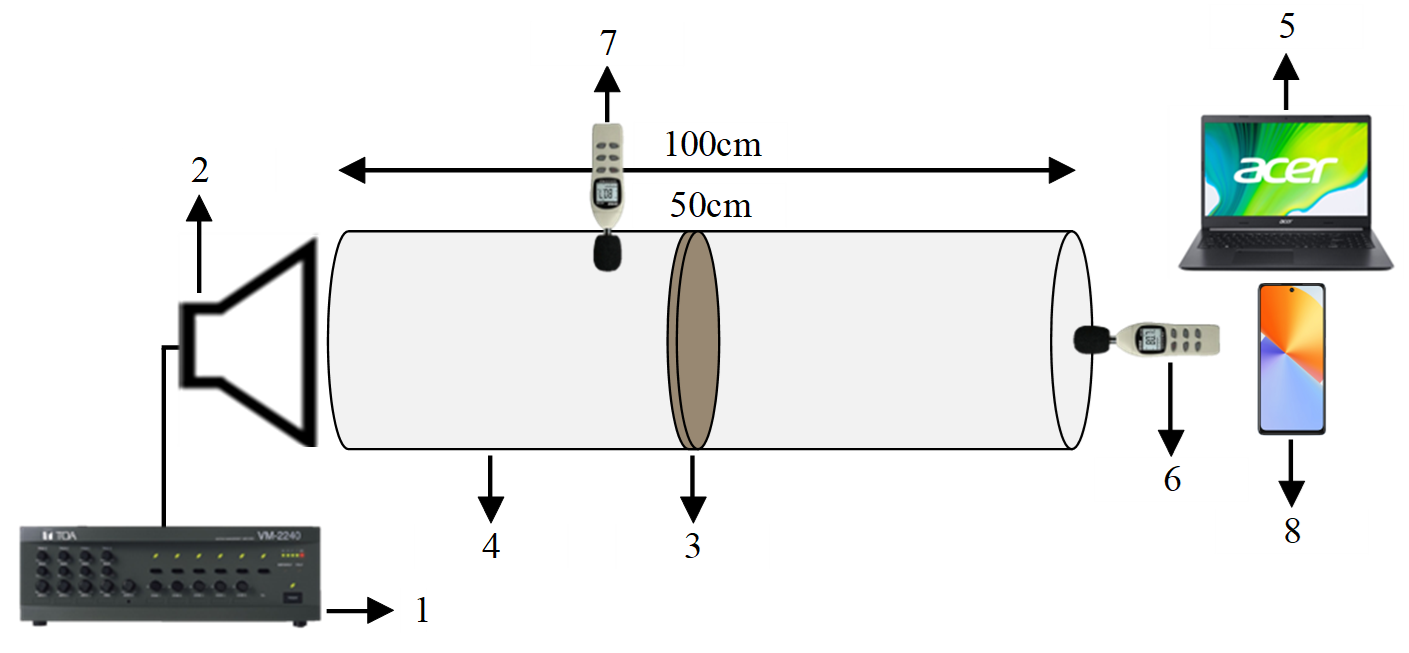
: Noise is a sound pollution that has a significant impact on human health and the environment. The use of bagasse waste as a noise dampener is an interesting alternative material source to be developed. This study aims to determine the effect of the ratio of epoxy resin and particle dimensions of bagasse waste on the effectiveness of noise dampening materials. The study was conducted experimentally, where the composite was made using variations in the ratio of epoxy resin to bagasse, namely: 10:40, 10:50, and 10:60 grams. Bagasse particle powder used three different mesh sizes, namely 16, 20, and 30. Testing the sound absorption capacity of the dampening specimen was carried out using a PVC impedance tube with a length of 100 cm and a diameter of 15 cm, the sound source used a frequency of 50 Hz–1000 Hz with the specimen placed at a distance of 50 cm and 75 cm from the sound source. The results showed that the ratio of epoxy resin and particle dimensions of bagasse affected the reduction of noise levels. The increase in the ratio of epoxy resin and bagasse powder is directly proportional to the composite density value, where the highest density value of 0.78 g/cm³ is obtained at a composition of 10:60 grams at a mesh size of 20, while the lowest density is 0.54 g/cm³ at a composition of 10:40 grams mesh 16. The most optimal sound absorption coefficient is achieved at a mixture ratio of 10:60 grams mesh 30 with an effectiveness of 10% at a distance of 50 cm from the noise source.
References
[1] J. Ilmiah et al., “‘Dampak Kebisingan Suara Kendaraan Terhadap Konsentrasi Belajar Mahasiswa PGMI Semester 5,’” vol. 8, no. 10, pp. 128–133, 2024.
[2] M. Balirante, L. I. R. Lefrandt, and M. Kumaat, “Analisa Tingkat Kebisingan Lalu Lintas Di Jalan Raya Ditinjau Dari Tingkat Baku Mutu Kebisingan Yang Diizinkan,” J. Sipil Statik, vol. 8, no. 2, pp. 249–256, 2020.
[3] N. M. Kamal, “Tingkat Kebisingan Kawasan Perumahan dan Perbelanjaan Kecamatan Manggala di Kota Makassar,” Maras J. Penelit. Multidisiplin, vol. 2, no. 1, pp. 508–514, 2024, doi: 10.60126/maras.v2i1.212.
[4] D. K. Wardhani and J. Mukono, “Sensorineural Hearing Loss Due to Exposure of Noisy Trains on Populations Around Turirejo Train Railroad Cross,” J. Kesehat. Lingkung., vol. 12, no. 1, pp. 59–68, 2020, doi: 10.20473/jkl.v12i1.2020.59-68.
[5] Muhammad Munir and Dzulkiflih, “Pemanfaatan Fluk pada Styrofoam sebagai Bahan Dasar Peredam Suara dengan Metode Tabung Impedansi,” Inov. Fis. Indones., vol. 04, no. 1, pp. 41–47, 2015.
[6] H. Herdianto, M. A. Z. Farich, N. Silikat, and A. Tebu, “Dengan Template Serat Sabut Kelapa,” J. Penelit. Fis. dan Apl., vol. 5, no. 1, pp. 1–8, 2015.
[7] Rifaida Eriningsih, Mukti Widodo, and Rini Marlina, “Pembuatan Dan Karakterisasi Peredam Suara Dari Bahan Baku Serat Alami,” Arena Tekst., vol. 29, no. 1, pp. 1–8, 2014.
[8] N. Nabila and A. Mahyudin, “Pengaruh Ketebalan Pelepah Pisang terhadap Koefisien Absorpsi Material Akustik,” J. Fis. Unand, vol. 9, no. 2, pp. 244–249, 2020, doi: 10.25077/jfu.9.2.244-249.2020.
[9] M. Raj, S. Fatima, and N. Tandon, “An experimental and theoretical study on environment-friendly sound absorber sourced from nettle fibers,” J. Build. Eng., vol. 31, no. May, 2020, doi: 10.1016/j.jobe.2020.101395.
[10] M. . Sahida and M. Farid, “‘Pengaruh Variasi Komposit Serat Terhadap Nilai Koefisien Absorpsi Suara Dan Sifat Mekanik Pada Komposit Serat Ampas Tebu Dan Bambu Betung Dengan Matriks Gypsum,’” Dr. Diss., pp. 1–5, 2015.
[11] T. P. Sari and E. Elvaswer, “Pengaruh Densitas Panel Serat Ampas Tebu terhadap Koefisien Absorbsi Bunyi dan Impedansi Akustik,” J. Fis. Unand, vol. 9, no. 3, pp. 304–310, 2020, doi: 10.25077/jfu.9.3.304-310.2020.
[12] B. C. Bimara, A. R. Azizah, T. A. Wulansari, U. Nurbaiti, and F. Fianti, “Analisis Material Serat Alam Tebu Sebagai Bahan Peredam Suara PUSAT,” J. Fis. Fis. Sains dan Apl., vol. 6, no. 2, pp. 97–100, 2021, doi: 10.35508/fisa.v6i2.6839.
[13] M. Yani, B. Suroso, and R. Rajali, “Mechanical Properties Komposit Limbah Plastik,” J. Rekayasa Mater. Manufaktur dan Energi, vol. 2, no. 1, pp. 74–83, 2019, doi: 10.30596/rmme.v2i1.3071.
[14] S. Yuliantika and E. Elvaswer, “Karakterisasi Koefisien Absorbsi Bunyi Dan Impedansi Akustik Dari Limbah Serat Kayu Meranti Merah (Shorea Pinanga) Dengan Menggunakan Metode Tabung,” J. Ilmu Fis. | Univ. Andalas, vol. 10, no. 1, pp. 28–37, 2019, doi: 10.25077/jif.10.1.28-37.2018
Downloads
Published
Issue
Section
License
Copyright (c) 2026 Adhi Purna Yulian Putra, Anas Mukhtar, Gatut Rubiono, Muhamad Khoirul Anam, Adi Pratama Putra

This work is licensed under a Creative Commons Attribution-ShareAlike 4.0 International License.

This work is licensed under a Creative Commons Attribution-ShareAlike 4.0 International License.