Field-Based Performance Analysis of Turbofan Engines Operating in Tropical Indonesian Commercial Aviation.
DOI:
https://doi.org/10.36526/jeee.v5i1.7992Keywords:
Brayton cycle, aircraft performance, specific fuel consumption, tropical operations, Turbofan engineAbstract
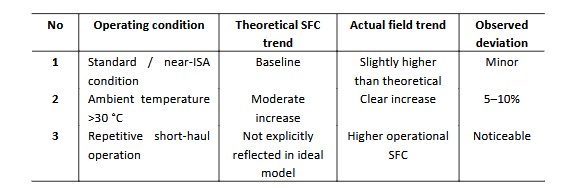
This study presents a field-based performance analysis of turbofan gas turbine engines operating in Indonesia’s commercial aviation sector under tropical environmental conditions. The research focuses on how ambient temperature, humidity, operational frequency, and short-haul flight patterns influence actual engine performance relative to ideal thermodynamic expectations. A mixed-method design was applied by combining literature-based Brayton-cycle modeling with empirical operational data from CFM56 and V2500 engine families. Data sources included engine logbooks, maintenance records, operational observations, and ambient condition monitoring at selected Indonesian airports. The analysis shows that actual specific fuel consumption (SFC) was consistently 5-10% higher than theoretical estimates under high-temperature operating conditions, particularly above 30 °C. Field observations also indicated reduced thrust margins, increased exhaust gas temperature (EGT), and decreasing propulsive efficiency during high-load flight phases, especially takeoff and climb. These deviations confirm that tropical operating conditions and repetitive short-sector utilization accelerate performance deterioration beyond ideal-cycle assumptions. The main scientific contribution of this study is the demonstration that Brayton-cycle-based turbofan performance prediction for Indonesian commercial aviation requires correction for local environmental and operational factors. The findings support the use of climate-adaptive performance assessment and condition-based maintenance strategies to improve engine efficiency, reliability, and operational safety.
References
[1] Z. Xu, “Study of Turbofan Engine Components and Performance with Overheating Problems,” Appl. Comput. Eng., vol. 114, pp. 178–185, 2024.
[2] “An overview of the working principle and application of turbofan engine,” Intern. Combust. Engines Accessories, vol. 1, pp. 68–70, 2018, doi: 10.19475/j.cnki.issn1674‑957x.2018.01.032.
[3] R. W. Gao, T. Zhang, and S. Liu, “High-bypass Ratio, Separate-exhaust Turbofan engine: Study on Flight Mach Number and Inlet Temperature,” J. Chinese Soc. Mech. Eng., vol. 46, no. 2, pp. 185–193, 2025.
[4] T. Nikolaidis, S. Jafari, D. Bosak, and P. Pilidis, “Exchange Rate Analysis for Ultra High Bypass Ratio Geared Turbofan Engines,” Appl. Sci., vol. 10, no. 21, 2020, doi: 10.3390/app10217945.
[5] P. J. Walsh and P. Fletcher, Gas Turbine Performance. Wiley-Blackwell, 2018.
[6] A. Sopiyani and D. I. Santoso, “Operational and Maintenance Challenges of CFM56 Engines on Boeing 737 Aircraft Operating in Indonesian Tropical Climate,” Aviat. J. Indones., vol. 12, no. 2, pp. 89–97, 2021.
[7] M. Alsharif, A. Alazab, and Y. A. Nazzal, “Gas Turbine Health Monitoring Using Real-Time Sensor Data and Predictive Algorithms,” Energies, vol. 14, no. 4, p. 1023, 2021, doi: 10.3390/en14041023.
[8] R. S. Rizki, C. B. Ardiansyah, A. Winda, H. Prayitno, and S. Musa, “Analisis Dinamika Performa Engine Turbofan Pada Boeing 737- 300 Dalam Kondisi Idle Hingga Take-Off,” SKYHAWK J. Aviasi Indones., vol. 5, no. 1, pp. 432–439, 2025, doi: 10.52074/skyhawk.v5i1.312.
[9] R. F. M, Z. Nuurul, A. F. K, and H. Prayitno, “Analisis Perkembangan Teknologi Boeing 737 Terhadap Masa Depan Dunia Penerbangan Sipil: boeing 737, MAX, NG, pesawat komersial, sejarah penerbangan …,” J. …, vol. 9, no. 4, pp. 343–351, 2024, http://ejournal.poltekbangsby.ac.id/index.php/jurnalpenelitian/article/view/1871
[10] J. Mattingly, Elements of Gas Turbine Propulsion. McGraw-Hill, 2005.
[11] F. A. I. Rahim, “Analisis Pengaruh Rotor Clearance pada High Pressure Compressor dan High Pressure Turbine terhadap Penurunan Exhaust Gas Temperature Margin pada Mesin CFM56‑3C1,” J. Mech. Eng. Mercubuana Univ., vol. 12, no. 2, 2023, https://publikasi.mercubuana.ac.id/index.php/jtm/article/view/16716
[12] E. T. Turgut, “Effects of Ambient Air Temperature on Gaseous Emissions of Turbofan Engines,” Anadolu Univ. Repos., 2016, https://aperta.ulakbim.gov.tr/record/55173
[13] S. Nugroho and I. C. Riyadi, “Analisis Thermal Cycling Mesin CFM56-7B pada Siklus Penerbangan Pendek di Indonesia,” J. Tek. Dirgant., vol. 11, no. 2, 2022, https://jurnalteknikdirgantara.org/article/view/179
[14] M. Seitzman, “Gas Turbine Transient Response and Wear Mechanisms,” 2019, https://seitzman.gatech.edu/propulsion-notes
[15] R. A. Putra, “Benefits of Engine Condition Monitoring System (ECMS) Implementation in A320 Aircraft: A Case from Indonesia,” Asian Aviat. J., vol. 4, no. 1, 2023, https://asianaviationjournal.org/index.php/aaj/article/view/101
Downloads
Published
Issue
Section
License
Copyright (c) 2026 Aries Putra Pramadya, Andi Theda Mufarrihah Anwar, Hadi Prayitno

This work is licensed under a Creative Commons Attribution-ShareAlike 4.0 International License.

This work is licensed under a Creative Commons Attribution-ShareAlike 4.0 International License.