Prototype Phase Failure Detection Berbasis Internet Of Things (IoT)
Keywords:
PLN Network, NodeMCU ESP8266, Phase Failure DetectionAbstract
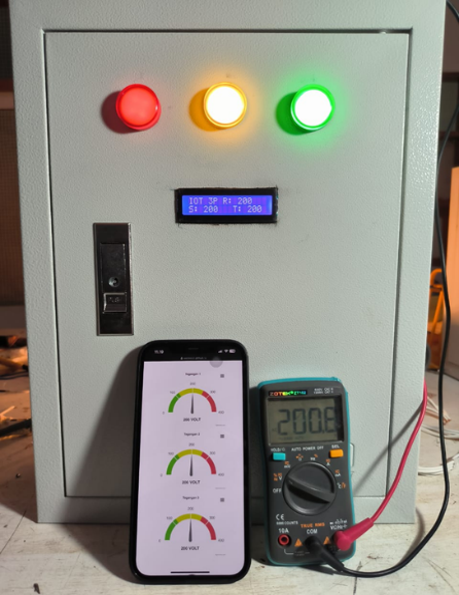
The three-phase system is applied to the electricity network supplied by PLN, starting from the generator to the low voltage network (JTR) in front of people's homes. The PLN network uses three-phase lines (R, S, T) and neutral (N), or often called ground. According to the term three-phase power, it consists of three live cables and one neutral cable. Usually three-phase power supplies have a voltage of 380 volts and are widely used in industry and factories. Previous research to detect Phase failure still used conventional methods so it was difficult to control. This once happened at a hospital where the researcher worked, which experienced damage to a 3 Phase electric motor and a 3 Phase submersible water pump due to the failure of one of the Phases of the electrical network without being recognized and controlled by the Phase failure system. Currently, much of the technology used in equipment is operated manually, so the efficiency in terms of time, energy and accuracy is not optimal. This research carried out the design and development of a prototype Phase Failure Detection system which, when applied, can function as a safety measure, can monitor or monitor in real time, and can also remotely control the function of a 3 Phase electrical network using an Android system based on the Internet of Things. . The Phase Failure Detection working system is that if there is a phase imbalance (R, S, T) that exceeds the value set by the software, it will provide information via LCD, LED indicator and buzzer (alarm). NodeMCU ESP8266 in real-time. The voltage measurement value on the LCD (Contactor input voltage) is close to the voltage value measured using the AVOmeter. From the results of the research, 8 measurements were carried out in each phase, including a voltage of 220V - 196V in each phase R, S, T, and showed a maximum voltage error value for each phase of 0.50%, namely at a phase voltage of 199 volts. The voltage value shown by the AVOmeter is relatively the same as the voltage value shown by the LCD, so it can be concluded that the research results in the form of a prototype of this tool have a high level of accuracy because the percentage value of the allowable deviation coefficient between phases (10% of the nominal voltage of 220 volts) not exceeded [1], and when there is a deviationin the voltage value between Phases that exceeds 10%, the device automatically cuts off the flow of each Phase
References
[1] R. Budi and W. Suryono, “Monitoring Fasa Dan Daya Wemos D1 Mini Menggunakan Smartphone,” Prosiding SNITP (Seminar …, 2020.
[2] R. Vaswani and R. A. Kusuma, “Analisa Jaringan Distribusi Tegangan Menengah Dengan Sistem Single Wire Earth Return Untuk Wilayah Tertinggal, Terdepan Dan Terluar,” Jurnal Kajian Teknik Elektro, vol. 7, no. 1, pp. 1–9, 2022, doi: 10.52447/jkte.v7i1.5888.
[3] Atmam, A. Tanjung, and Zulfahri, “Analisis Penggunaan Energi Listrik Motor Induksi,” jurnal SainETIn, vol. 2, no. 2, pp. 52–59, 2018.
[4] S. Hariyadi, H. Hartono, R. I.S., S. Setiyo, and S. Julaihah, “Sistem Kontrol Dan Monitoring Aliran Daya Listrik Pada Jaringan Distribusi Tegangan Rendah Menggunakan Mikrokontroler Berbasis Iot,” Jurnal Penelitian, vol. 8, no. 2, pp. 151–164, 2023, doi: 10.46491/jp.v8i2.1501.
[5] R. H. Hervan Fernando Sitorus, armansyah, “Pemeliharaan Motor Induksi 3 Fasa Tegangan 380 V Pada GT 2.1 di PT. PLN (Persero) Unit Pelaksana Pengendalian Pembangkitan Belawan,” JET (Journal of Electrical …, vol. 1099, pp. 119–123, 2022.
[6] F. M. Noor and A. F. Rahman, “Studi Penerapan Integrasi Sumber Energi Baru Terbarukan dengan Smart grid dan Sistem Pengendalian SCADA,” Prosiding Industrial Research Workshop …, pp. 526–532, 2023.
[7] M. Basjir and Suhartini, “Analisa Risiko Prioritas Perbaikan Kegagalan Proses Penjernihan Air Dengan Metode Fuzzy FMEA Kebutuhan manusia produksinya . Kegagalan adalah suatu kejadian dimana terjadi kondisi,” Tecnoscienza, vol. 03, no. 02, pp. 196–210, 2019.
[8] R. Ridwan, E. Purwanto, H. Oktavianto, M. R. Rusli, and H. Toar, “Desain Kontrol Kecepatan Motor Induksi Tiga Fasa Menggunakan Fuzzy Pid Berbasis Idirect Field Oriented Control,” Jurnal Integrasi, vol. 11, no. 2, pp. 146–155, 2019, doi: 10.30871/ji.v11i2.1356.
[9] B. Sasongkojati and M. Fatkhurrokhman, “Analisis Prinsip Kerja Panel Sinkron Genset dengan Modul DEIF AGC-150 pada PT Tiga Kreasi Indonesia,” 2024.
[10] M. Ridwan, “Rancang Bangun Sistem Pendeteksi Kebocoran Gas LPG Berbasis IoT,” Jurnal Sains dan Ilmu Terapan, vol. 4, no. 1, pp. 35–39, 2021, doi: 10.59061/jsit.v4i1.94.
[11] D. N. Yuniar, F. T. Syifa, and N. A. Zen, “Sistem Monitoring Kekeruhan Air dan Kontrol Pintu Pembuangan Irigasi Sawah menggunakan Blynk,” 2022.
[12] W. W. Sakti, K. Anam, S. B. Utomo, B. Marhaenanto, and S. Nahela, “Artificial Intelligence IoT based EEG Application using Deep Learning for Movement Classification,” in 2021 8th International Conference on Electrical Engineering, Computer Science and Informatics (EECSI), 2021, pp. 192–196. doi: 10.23919/EECSI53397.2021.9624269.
[13] A. N. Syawaluddin, “Rancang Bangun Sistem Absensi Online Menggunakan Nfc Berbasis Iot Di Universitas Serang Raya,” Jurnal PROSISKO, vol. 6, no. 2, pp. 88–95, 2019.
[14] L. A. Subagyo and B. Suprianto, “Sistem Monitoring Arus Tidak Seimbang 3 Fasa Berbasis Arduino Uno,” Jurnal Teknik Elektro, vol. 6, no. 3, pp. 213–221, 2017.
[15] N. Kalbuana and B. Kurnianto, “Design of Microcontroller Sensor-Based Smoke Detection System as an Effort for Fire Prevention Desain Sistem Deteksi Asap Berbasis Sensor Mikrokontroler Sebagai Upaya Pencegahan Kebakaran,” vol. 4, no. January, pp. 266–272, 2024.
[16] PUIL, “PerPUIL. (2000). Persyaratan Umum Instalasi Listrik 2000 (PUIL 2000). Standar Nasional Indonesia DirJen Ketenagalistrikan, 2000(Puil), 562.syaratan Umum Instalasi Listrik 2000 (PUIL 2000),” Standar Nasional Indonesia DirJen Ketenagalistrikan, vol. 2000, no. Puil, p. 562, 2000.
Downloads
Published
Issue
Section
License
Copyright (c) 2026 Arif Dwi Wahyudi, Charis Fathul Hadi, Ratna Mustika Yasi

This work is licensed under a Creative Commons Attribution-ShareAlike 4.0 International License.

This work is licensed under a Creative Commons Attribution-ShareAlike 4.0 International License.